Trident maple
Acer buergerianum

- 1of 3, difficulty
- 6styles it carries
- Outdoorall year
- NovemberRemove any wire that is starting to bite.
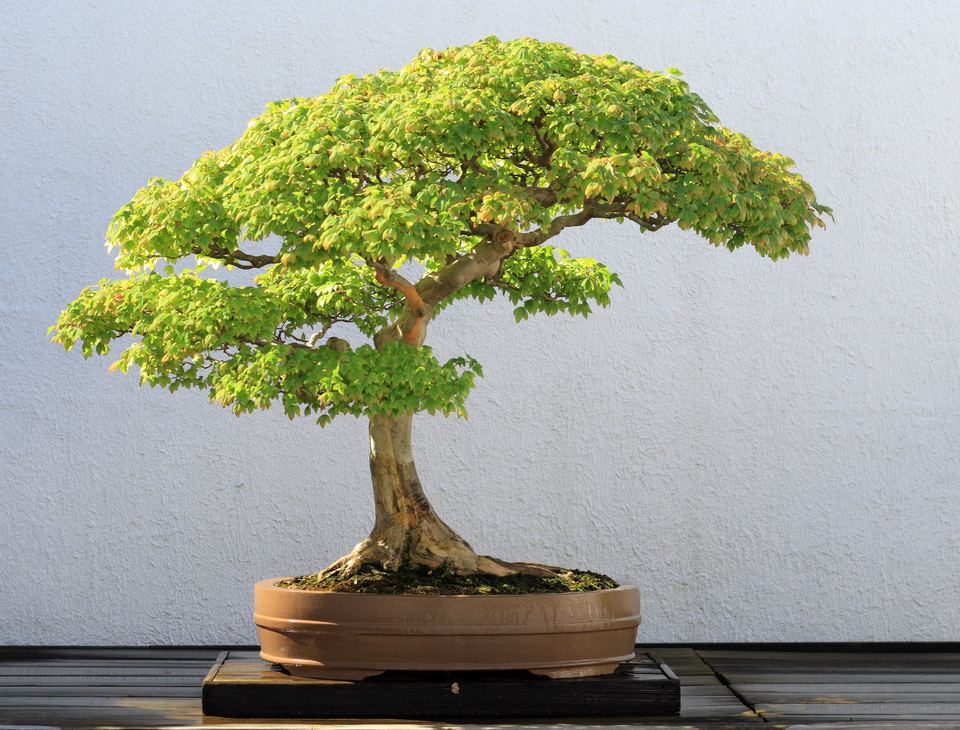
A vigorous, forgiving maple with small three-lobed leaves and a trunk that thickens fast; the best deciduous tree for a beginner who wants to build something.
- Lives
- Outdoor
- Hardiness
- RHS H6: hardy in the ground; the fleshy roots in a pot are more frost-tender than the top, so protect the pot in a hard frost and never let it freeze solid for days USDA 6b/7a, the RHS's own equivalent.
- Leaves
- small leaves
- Styles
- informal upright, broom, root over rock, forest group, slanting, formal upright
- Soil
- 2 parts akadama, 1 part pumice, 1 part lava (by volume); for a tree being thickened in a large training pot, a coarser mix with more lava
The year
Timings for a temperate northern climate.
- Repot
- Wire
- Prune
- Pinch
- Protect
- Feed
- Water
- Watch for pests
- J
- F
- M
- A
- M
- J
- J
- A
- S
- O
- N
- D
- JanuaryDormant outside, with the pot on the ground in a sheltered corner or in a cold frame for spells of hard frost.
- FebruaryThe month for big cuts: a trunk chop or the removal of a heavy branch, sealed, while the tree is dormant and will callus from spring.
- MarchRepot as the buds swell, every year or two for a young tree and every two or three for an old one, because the roots fill the pot faster than any other maple.
- AprilLeaves open and growth starts fast.
- MayGrowth is at its fastest and water is the job: a trident in a shallow pot can need watering twice a day in a warm spell.
- JuneCut back the spring extension to one or two pairs of leaves on every shoot you want to ramify, and remove any shoot growing straight up or down from a branch.
- JulyWater, every day and more in heat; a trident wilts fast and recovers, but the shoot tips it loses are next year's twigs.
- AugustAs July, with the second flush pinched as it comes.
- SeptemberGrowth slows and stops.
- OctoberAutumn colour in the second half of the month in a good year; stop feeding altogether.
- NovemberDormant.
- DecemberKeep it cold, damp and sheltered, and keep the fleshy roots from freezing solid for days at a time.
The whole year
- Akadama (hard, medium grade) Check price on Amazon Search eBay
- Pumice (3 to 6 mm) Check price on Amazon Search eBay
- Lava rock (kiryu or black lava, 3 to 6 mm) Check price on Amazon Search eBay
- Drainage mesh and tie-in wire Check price on Amazon Search eBay
- Root hook and rake Check price on Amazon Search eBay
- Bamboo chopsticks (plain) Check price on Amazon Search eBay
- Anodised aluminium wire, 1 to 4 mm Check price on Amazon Search eBay
- Bonsai wire cutter Check price on Amazon Search eBay
- Bonsai shears (long-handled, stainless) Check price on Amazon Search eBay
- Concave branch cutter Check price on Amazon Search eBay
- Cut paste (wound sealant) Check price on Amazon Search eBay
- Slow-release organic fertiliser pellets Check price on Amazon Search eBay
- Frost fleece (frost cloth) Check price on Amazon Search eBay
- Cold frame Check price on Amazon Search eBay
- Pot wrap Check price on Amazon Search eBay
Rules of thumb; your garden varies. The full calendar, with print, PDF and a calendar file.
The whole profile
Acer buergerianum comes from the warm, humid lowlands of eastern China and was taken to Japan centuries ago, where it became one of the three or four species the whole art of deciduous bonsai was worked out on. It is a street tree in its own country, a tough, fast, thirsty thing that shrugs off pollution, heat and hard pruning. It is less often seen in gardens than it deserves, which is a pity, because in a pot it is the most forgiving deciduous tree a beginner can buy and the one that will teach them most.
What makes it a bonsai tree is its vigour. A trident thickens its trunk faster than any temperate species in common use, so a seedling grown hard in the ground or a big box for five or six years, chopped and regrown, becomes a trunk with real taper and a flared base in a decade rather than a lifetime. The leaves are small, three-lobed and glossy, and they reduce to the size of a fingernail under pot culture. The bark starts smooth and grey and on an old tree flakes into orange and grey plates. The roots are fleshy and fuse readily, which is why the species is the standard choice for root-over-rock and for the great flat spreading nebari that make a trunk look as if it has stood for a century.
The same vigour is what beginners get wrong. A trident left to grow will put out shoots a metre long, with internodes you could fit a finger between, and all of that energy goes to the top of the tree and the ends of the branches while the inner shoots fade. Keeping one is a matter of cutting back constantly in the growing season and, on a tree that is being refined rather than thickened, pinching the shoots as they open. The second mistake is the roots. Tridents build so much fleshy root that a tree in a bonsai pot can lift itself out in two seasons and become impossible to water; they want repotting far more often than a Japanese maple, every year or two while young. The third is winter: those thick roots are full of water and sugar and can rot or freeze, so the pot needs protection in a hard frost even though the tree above it is perfectly hardy.
Through the year a trident lives outside in full sun. Unlike its Japanese cousin it does not scorch in an ordinary temperate summer, and the sun keeps the internodes short and the leaves small; a trident in shade grows long and coarse. It wants a great deal of water in summer. In winter it stays outside, bare, with the pot on the ground or in a cold frame when the forecast is for several days of hard frost, and back out when it softens. A greenhouse that gets warm on a sunny February day will break its dormancy early and set it up for frost damage, so unheated and shaded is better than warm.
The growth habit is simple. Buds swell in late March, the leaves open in April, and the shoots run until the tree is stopped, either by you or by August. It is strongly apically dominant and back-buds readily on old wood, even from a bare trunk after a hard chop, which is the quality that makes trunk-building possible. Cuts heal fast and large wounds close in a few seasons if they are sealed and the tree is fed. In refinement, pinching the opening shoots to one pair of leaves, cutting back in early summer to one or two pairs, and defoliating a strong tree in June all work well and the tree takes them without complaint. In development, the opposite: let the sacrifice branches run, feed hard, cut back once in late winter.
Wire works on young shoots in late winter or just after leaf drop, but the bark marks and branches thicken so fast that wire must be checked weekly in May and June and is usually off within six to eight weeks. Most of the shaping is done by clip-and-grow: let a shoot extend, cut it back to a bud pointing the way you want, and let the next shoot take the line. It is slower than wire and the result looks like a tree.
The seasons give you glossy green through summer, then an autumn colour that depends on the year and the clone: orange and red in a good year after cool nights, yellow in a wet, mild one. Winter shows the twig structure, and on an older tree the bark. A trident is not as refined as a Japanese maple and does not pretend to be. It is a strong, honest tree that rewards work, and the best first deciduous bonsai there is.
Styles that suit it
- Informal upright (moyogi): the trunk thickens and tapers quickly, which is what the style needs most
- Broom (hokidachi): fine ramification from a cut trunk builds a dome of twigs in a few seasons
- Root over rock (sekijoju): the thick, grasping roots clasp a stone and fuse to it better than any other species commonly grown
- Forest group (yose-ue): cheap, fast-growing seedlings make a convincing grove quickly
- Slanting (shakan): a leaning trunk with a strong flare at the base is easy to develop from field-grown stock
- Formal upright (chokkan): possible from seed with patience, though the species' energy makes a perfectly straight, tapered trunk harder to hold than it looks
Soil, in detail
2 parts akadama, 1 part pumice, 1 part lava (by volume); for a tree being thickened in a large training pot, a coarser mix with more lava
Tridents eat and drink hard and build fleshy roots fast; the akadama holds the water they want and breaks down as the roots fill it, which is why they are repotted often.
Pot
Glazed, like all deciduous trees, in a shallow oval or rectangle about two thirds the tree's height in length and about as deep as the trunk is wide at the base, which for a developed trident with a heavy base means a surprisingly shallow, wide pot. A tree still being thickened belongs in a large plastic training pot or a wooden box, not a bonsai pot; the pot comes last.
The glossy, slightly coarse foliage takes a stronger glaze than a Japanese maple: a deep blue, a green, an oatmeal or a brown glaze all suit it, and a sharper-cornered rectangle suits a thick masculine trunk. Root-over-rock trees usually go in a shallow tray or on a slab, so the roots on the stone are the picture.
Pests and problems
Aphids on the spring shoots, dealt with by hand or with a soft-soap spray, and vine weevil grubs in the roots, dealt with by a nematode drench in late summer and spring. The thick roots are also attractive to woodlice and slugs in a damp pot; keep the surface clean and the pot off the ground on feet.
The tree is otherwise robust. Leaf scorch on a trident is unusual and usually means the pot dried out. A branch that dies back suddenly in summer, with the leaves still attached, should be removed to clean wood and the cut sealed; keep the tree strong and do not reuse its soil elsewhere.
Basis of each row
What every month's line rests on: RHS H6: hardy in the ground; the fleshy roots in a pot are more frost-tender than the top, so protect the pot in a hard frost and never let it freeze solid for days.
| Month | What to do | Basis |
|---|---|---|
| January | Dormant outside, with the pot on the ground in a sheltered corner or in a cold frame for spells of hard frost. The fleshy roots are the weak point: do not let the pot stand frozen solid for days, and do not let it sit in water either. Check the soil every week or so and water only if it is drying. Study the bare structure and decide which branches go. | rhs RHS: Acer buergerianum plant page (hardiness H6, sheltered position); RHS advice: overwintering container plants |
| February | The month for big cuts: a trunk chop or the removal of a heavy branch, sealed, while the tree is dormant and will callus from spring. Fleshy roots can be reduced hard at repotting, but that waits for bud swell. In a mild year the buds move in the last week, and from then on the tree should stay in one place rather than going in and out of shelter. | reference Harry Harrington, bonsai4me.com species guide (Acer buergerianum): hard pruning in late winter; general practice on sealing |
| March | Repot as the buds swell, every year or two for a young tree and every two or three for an old one, because the roots fill the pot faster than any other maple. A healthy trident takes a hard root pruning, half or more, and recovers. Set it in fresh mix at the same depth, water well, and keep it out of frost and wind for three or four weeks. No feed until the leaves harden. | reference Peter Chan, Bonsai Masterclass (trident maples repotted at bud swell, hard root reduction tolerated); general practice |
| April | Leaves open and growth starts fast. Protect new leaves from late frost with fleece on clear, still nights. On a tree in refinement, pinch each new shoot back to the first pair of leaves as it opens, strong shoots first; on a tree being thickened, let everything run. Water daily as soon as the surface dries. Full sun from now on. | reference Harry Harrington, bonsai4me.com (trident maple: pinching in refinement, free growth in development) |
| May | Growth is at its fastest and water is the job: a trident in a shallow pot can need watering twice a day in a warm spell. Begin feeding when the leaves have hardened, with a balanced feed every week or fortnight for a tree in development and half that for one in refinement. Keep pinching. Check any wire from the winter every few days; it bites fast now and usually comes off this month. | practice General bonsai practice: feed after leaves harden; wire checked often on fast-thickening maples |
| June | Cut back the spring extension to one or two pairs of leaves on every shoot you want to ramify, and remove any shoot growing straight up or down from a branch. A strong, established tree can be fully defoliated in early June for a second, smaller set of leaves and finer twigging; not a weak tree, and not one repotted this spring. Water and feed as in May. | reference Peter Chan, Bonsai Masterclass; Harry Harrington, bonsai4me.com: June defoliation of strong trident maples |
| July | Water, every day and more in heat; a trident wilts fast and recovers, but the shoot tips it loses are next year's twigs. Keep pinching the regrowth on a refined tree. Feed lightly. Sacrifice branches on a tree in development are left to run; everything else is kept tidy. Do not wire in summer. | practice General bonsai practice for vigorous deciduous trees in summer |
| August | As July, with the second flush pinched as it comes. Late in the month, drench the pot with vine weevil nematodes while the soil is warm. Long shoots that have escaped can be cut back now without harm; the tree will still have time to harden the regrowth. | rhs RHS advice: vine weevil (nematodes applied in late summer); general practice on late-summer tidying |
| September | Growth slows and stops. Two low-nitrogen feeds (a tomato feed at half strength) harden the wood for winter; then stop. Water less as the days shorten and the nights cool. This is a good month to check the nebari and remove any root that has heaved above the soil, sealing the cut. | practice General bonsai practice: low-nitrogen autumn feed; surface-root tidying in early autumn |
| October | Autumn colour in the second half of the month in a good year; stop feeding altogether. Once the leaves drop, the twigging is visible and light wiring of young shoots can be done, to be checked monthly and removed by April. Clear the fallen leaves from the pot. A tree in development can have its sacrifice branches cut back now or in February. | reference Harry Harrington, bonsai4me.com (trident maple: wiring after leaf drop); general practice on hygiene |
| November | Dormant. Water only when the soil is drying; in a wet month the risk is the opposite, so raise the pot on feet and tilt it a little so it drains. Start the frost routine: sheltered outside, cold frame or unheated shed for the hard nights, out again after. Remove any wire that is starting to bite. | rhs RHS advice: overwintering container plants (drainage, raising pots, shelter in hard frost) |
| December | Keep it cold, damp and sheltered, and keep the fleshy roots from freezing solid for days at a time. Check after each frost that the soil has drained. Light tidying of crossing twigs can be done on a bare tree at any time; the big cuts wait for February. Order akadama and a bigger training pot if the tree is being thickened; it will need both in March. | practice General bonsai practice for dormant deciduous trees; estimate on root frost sensitivity of fleshy-rooted maples, widely reported by growers |