Scots pine
Pinus sylvestris

- 2of 3, difficulty
- 6styles it carries
- Outdoorall year
- NovemberMove an exposed tree to a sheltered spot before the first ha…
A pine of cool, wet climates, with short blue-green needles, flaking orange bark and a tolerance for grey summers that the Japanese pines lack.
- Lives
- Outdoor
- Hardiness
- RHS H7: hardy in severe winters. USDA 6a-1, the RHS's own equivalent.
- Leaves
- needles
- Styles
- informal upright, slanting, literati, windswept, formal upright, forest group
- Soil
- 2 parts pumice, 1 part akadama, 1 part lava rock (by volume), 3 to 6 mm; a coarser mix than for deciduous trees
The year
Timings for a temperate northern climate.
- Repot
- Wire
- Prune
- Pinch
- Protect
- Feed
- Water
- Watch for pests
- J
- F
- M
- A
- M
- J
- J
- A
- S
- O
- N
- D
- JanuaryFully dormant.
- FebruaryStill dormant.
- MarchRepot in the second half of the month as the buds begin to swell, every three to five years for an established tree, taking no more than a quarter to a third of the roots and keeping some of the old soil with its…
- AprilThe candles extend.
- MayFinish any candle work early in the month before the needles open.
- JuneNeedles harden.
- JulyWater daily, more in heat; a pine in a gritty mix can dry out in a day.
- AugustContinue watering and feeding.
- SeptemberThe best month to wire: the branches have hardened and will set over winter.
- OctoberFinish wiring early in the month.
- NovemberDormant.
- DecemberLeave it be.
The whole year
- Akadama (hard, medium grade) Check price on Amazon Search eBay
- Pumice (3 to 6 mm) Check price on Amazon Search eBay
- Lava rock (kiryu or black lava, 3 to 6 mm) Check price on Amazon Search eBay
- Drainage mesh and tie-in wire Check price on Amazon Search eBay
- Root hook and rake Check price on Amazon Search eBay
- Bamboo chopsticks (plain) Check price on Amazon Search eBay
- Anodised aluminium wire, 1 to 4 mm Check price on Amazon Search eBay
- Bonsai wire cutter Check price on Amazon Search eBay
- Copper wire (for conifers, once you're comfortable wiring) Check price on Amazon Search eBay
- Bonsai shears (long-handled, stainless) Check price on Amazon Search eBay
- Concave branch cutter Check price on Amazon Search eBay
- Slow-release organic fertiliser pellets Check price on Amazon Search eBay
- Frost fleece (frost cloth) Check price on Amazon Search eBay
- Cold frame Check price on Amazon Search eBay
- Pot wrap Check price on Amazon Search eBay
Rules of thumb; your garden varies. The full calendar, with print, PDF and a calendar file.
The whole profile
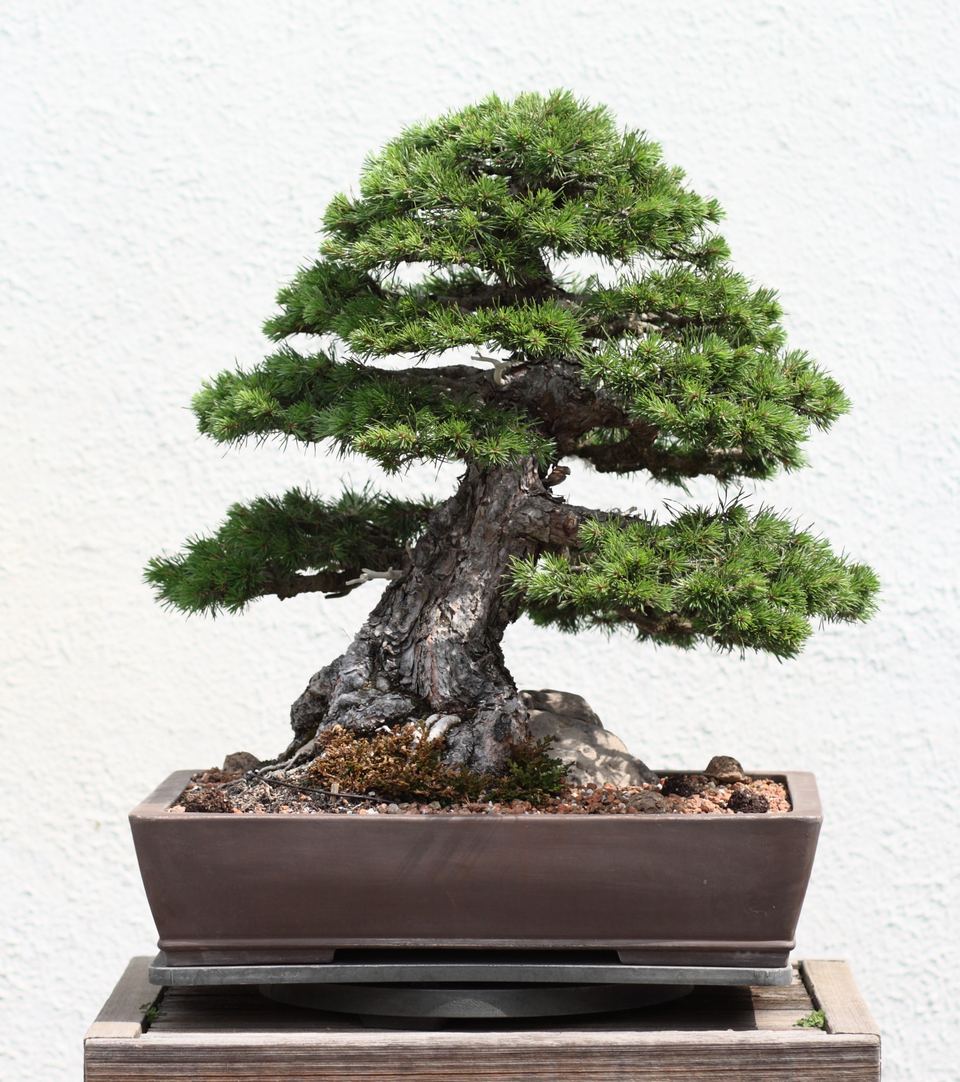
The Scots pine is the only pine native to Britain, the tree of the Caledonian forest and of sandy heaths across England, and one of the most widely distributed conifers in the world, from Spain to Siberia. It is a two-needle pine with short, twisted, blue-green needles and a bark that turns a warm flaking orange on the upper trunk and branches with age. In the wild it grows straight when crowded and crooked when alone, and old specimens flatten their crowns into the broad, layered silhouette that a pine bonsai aims to capture.
It suits a temperate garden because it was made for one. Where the Japanese black and white pines that fill the books sulk in a cool, cloudy summer, the Scots pine grows on. It is fully hardy, it tolerates poor soil, and it shortens its needles readily under bonsai culture, which the imported pines do grudgingly. Good young material is easy to find: forestry seedlings, garden-centre plants of the compact cultivars such as 'Watereri' and 'Beuvronensis', and collected trees from heathland with the landowner's permission.
Beginners go wrong with pines by treating them like a maple. A pine does not sprout from old wood on demand, so a branch cut back beyond its needles is a branch lost; it must be kept dense by working the growth it makes each year, not by cutting hard. The other error is too much water and too little sun. A pine wants the brightest place in the garden and a soil that dries, and it will tell you it is unhappy only slowly, by yellowing from the inside and dropping older needles, by which time the cause is months old.
Through the year it stays outside in full sun. Winter protection is rarely needed for the tree itself, but a shallow pot should be kept out of lying water and moved into a cold frame or against a wall during a hard freeze so the roots are not frozen and thawed repeatedly. Snow on the branches is harmless and worth a photograph; wind is the greater hazard, drying needles when the roots are frozen and cannot replace the water.
The growth cycle is what the work is built around. In spring each shoot extends as a candle, which can be shortened to balance the strength of the tree, the strongest candles cut most and the weakest left. The needles then open and harden through summer. In autumn old needles are pulled to let light into the interior and to even out vigour between strong and weak areas. Scots pine, unlike the Japanese black pine, is a single-flush pine: it is not decandled in summer to force a second set of shorter needles, because it does not have the strength to make them in a cool climate. Buds for next year form at the base of this year's growth, and where light reaches the interior they will also form on older wood, which is how a leggy pine is slowly brought back in.
The wood is strong and springy and holds a wire well, but it also thickens fast in spring, so wire applied in autumn and winter must be watched by May. Young branches can be bent surprisingly far; older ones need raffia or a guy wire and patience. The orange bark on a mature branch is the species' great beauty and is easily rubbed off by careless wiring, so the branches of an old tree are wrapped before they are bent.
Seasonal interest is in the needles and the bark. The new candles in April are pale and upright like small flames; the summer foliage is a dense blue-green; in winter the whole tree takes on a slightly duller, greyer tone, and the orange upper bark shows best against a grey February sky. A well-kept Scots pine looks like the tree on the hill it came from, which is the point of the species and the reason to choose it over a pine from somewhere else.
Styles that suit it
- Informal upright (moyogi): the natural habit of a mature Scots pine is a trunk with movement and a flat-topped crown, which is informal upright in all but name.
- Slanting (shakan): pines on exposed hillsides lean away from the wind, and a slanting trunk with branches drawn to one side reads true for this species.
- Literati (bunjin): the Scots pine's own old-age form is a tall, bare trunk with a small crown; literati is the species drawn from life.
- Windswept (fukinagashi): the flexible young branches can be set in one direction, and jin on the exposed side suits a tree from a Highland ridge.
- Formal upright (chokkan): a straight, well-tapered trunk with regular branch tiers is possible on young material and gives a classic, if austere, pine.
- Forest group (yose-ue): a group of three or five seedlings on a shallow slab recalls a stand of native pinewood.
Soil, in detail
2 parts pumice, 1 part akadama, 1 part lava rock (by volume), 3 to 6 mm; a coarser mix than for deciduous trees
Pines want air at the root more than water. A gritty, fast-draining mix keeps the mycorrhizal fungi the roots depend on healthy, and dries between waterings even in a wet summer; a water-retentive mix is the usual reason a pine declines.
Pot
A pine takes an unglazed pot, and the Scots pine, with its warm bark, looks best in a brown or iron-red clay rather than a cool grey. The rule of thumb is a length about two thirds of the height and a depth about the width of the trunk base; pines carry a slightly deeper pot than the rule suggests, because a dry, airy root ball is what they need and a very shallow pot dries unevenly.
A rectangle, with or without a lip, suits a strong upright or slanting pine. Literati takes a small round drum or a hexagonal pot that is almost incidental beneath the trunk, and a windswept tree sits toward one end of a shallow, plain oval so the sweep has somewhere to go. Drainage holes must be large and the pot must stand on feet.
Pests and problems
Adelgids, the small woolly aphids of pines, show as white fluff at the base of the needles in spring and can be wiped off or sprayed with a horticultural soap. Pine shoot moth bores into the candles and makes them wilt; cut out and bin affected shoots. Scale insects sit on older needles and stems as small brown or white bumps. Aphids on the new growth are a nuisance rather than a danger and a sharp spray of water deals with most of them.
The fungal problems are needle casts and blights, which brown bands on the needles and strip the interior; they are worst in a wet, still summer and are discouraged by light and air through the canopy. Root rot from a wet soil is the usual cause of a pine that yellows and dies back over a season. A pine that drops its oldest needles in autumn is behaving normally.
Basis of each row
What every month's line rests on: RHS H7: hardy in severe winters. In a shallow pot the roots are less hardy than the tree, so the risk is a root ball that freezes and thaws daily rather than cold itself..
| Month | What to do | Basis |
|---|---|---|
| January | Fully dormant. Keep the pot out of standing water and move it into a cold frame or against a wall when a hard freeze is forecast for several nights, returning it to the open when the freeze lifts. Water only when the soil is dry below the surface, perhaps once in the month. Shelter it from drying wind. | rhs RHS: Pinus sylvestris plant page (H7, native); RHS advice: overwintering plants in containers |
| February | Still dormant. Check wire from the autumn and remove any that is close to cutting in before the sap rises. Old needles that were not pulled in autumn can be removed now. Prepare soil for repotting next month. | practice general bonsai practice: late-winter wire checks and needle cleaning before spring thickening |
| March | Repot in the second half of the month as the buds begin to swell, every three to five years for an established tree, taking no more than a quarter to a third of the roots and keeping some of the old soil with its mycorrhiza. Set it into a coarse, open mix and keep it out of wind and frost for a month afterwards. Do not repot and candle-cut in the same year. | reference Harry Harrington, bonsai4me.com: Pinus sylvestris species guide (repotting in early spring, keep mycorrhiza); Peter Chan, Bonsai Masterclass |
| April | The candles extend. Begin feeding with a balanced feed as they move, weekly at low strength. Water as the surface dries. If the tree is strong, shorten the strongest candles by up to half and leave the weak ones whole, to balance vigour across the tree. | reference Harry Harrington, bonsai4me.com: Pinus sylvestris (single-flush pine; candle shortening to balance vigour) |
| May | Finish any candle work early in the month before the needles open. Water daily in dry spells and keep feeding. Watch for adelgid fluff at the base of the new needles and deal with it early. Keep the tree in full sun. | practice general bonsai practice for single-flush pines; RHS advice: adelgids |
| June | Needles harden. Water daily and feed every week or two. Do nothing structural; this is the month the tree builds the year's strength. Check spring wire, as the branches thicken fastest now. | practice general bonsai practice: summer growth, wire checks |
| July | Water daily, more in heat; a pine in a gritty mix can dry out in a day. Feed at half strength. Keep it in the brightest spot available. Light scissor removal of any shoots growing straight down or up on a branch can be done now. | practice general bonsai practice; RHS advice: watering container plants in summer |
| August | Continue watering and feeding. From the end of the month, needle-pull the strongest areas (leaving perhaps eight to twelve pairs per shoot) so light reaches the interior and the weak areas catch up. The main pruning window opens: remove unwanted branches and shorten shoots back to a bud or side shoot where one exists. | reference Bonsai Empire: Pine bonsai care guide (late-summer needle pulling and branch pruning); Peter Warren, Bonsai (DK) |
| September | The best month to wire: the branches have hardened and will set over winter. Change to a low-nitrogen feed. Water as needed. Pull old needles if not already done. | reference Harry Harrington, bonsai4me.com: Pinus sylvestris (autumn wiring and needle plucking) |
| October | Finish wiring early in the month. Stop feeding by mid-month. Remove yellowing old needles the tree is shedding. Raise the pot on feet and begin to reduce watering as the days shorten. | practice general bonsai practice: autumn needle shedding is normal; reduce water as growth stops |
| November | Dormant. Water sparingly and only when dry. Move an exposed tree to a sheltered spot before the first hard frost. Protect from wind more than from cold. | rhs RHS advice: overwintering plants in containers (wind desiccation of conifers) |
| December | Leave it be. Keep the root ball from freezing solid for days at a time with a cold frame or a wall; do not water a frozen pot. Snow on the branches can stay; wind should be kept off. | rhs RHS advice: protecting plants from frost |