Juniper
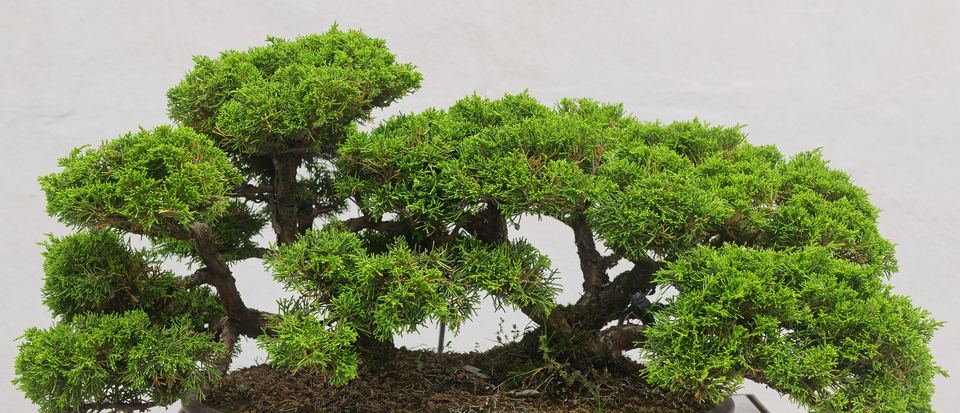
Juniperus chinensis 'Itoigawa' and J. procumbens 'Nana'

- 1of 3, difficulty
- 7styles it carries
- Outdoorall year
- NovemberIf the tree is in a very exposed spot, move it to shelter be…
The forgiving first conifer for most beginners, with scale foliage that pads beautifully and deadwood that tells a story.
- Lives
- Outdoor
- Hardiness
- RHS H7 for Juniperus procumbens 'Nana'; Chinese juniper cultivars are rated H6 to H7. USDA 6a-1, the RHS's own equivalent.
- Leaves
- scale foliage
- Styles
- informal upright, slanting, cascade, semi-cascade, windswept, literati, root over rock
- Soil
- 1 part akadama, 1 part pumice, 1 part lava rock (by volume), sieved to 2 to 6 mm; a little more pumice for a very wet garden
The year
Timings for a temperate northern climate.
- Repot
- Wire
- Prune
- Pinch
- Protect
- Feed
- Water
- Watch for pests
- J
- F
- M
- A
- M
- J
- J
- A
- S
- O
- N
- D
- JanuaryLeave the tree alone and outside.
- FebruaryStill dormant.
- MarchRepot in the second half of the month as the buds swell, every two years for a young tree and three to five for an established one, removing no more than a third of the roots and never bare-rooting a juniper.
- AprilGrowth begins.
- MayFull growth.
- JuneKeep watering daily and feeding fortnightly.
- JulyWater daily, twice on very hot days, and watch the pot does not dry through.
- AugustTowards the end of the month, when growth slows, do the main scissor work: shorten extended shoots back to side shoots, open the pads, and remove any juvenile foliage on 'Itoigawa' that is not wanted.
- SeptemberChange to a low-nitrogen feed to harden the growth for winter.
- OctoberStop feeding by the middle of the month.
- NovemberDormancy.
- DecemberNothing but watching.
The whole year
- Akadama (hard, medium grade) Check price on Amazon Search eBay
- Pumice (3 to 6 mm) Check price on Amazon Search eBay
- Lava rock (kiryu or black lava, 3 to 6 mm) Check price on Amazon Search eBay
- Drainage mesh and tie-in wire Check price on Amazon Search eBay
- Root hook and rake Check price on Amazon Search eBay
- Bamboo chopsticks (plain) Check price on Amazon Search eBay
- Anodised aluminium wire, 1 to 4 mm Check price on Amazon Search eBay
- Bonsai wire cutter Check price on Amazon Search eBay
- Copper wire (for conifers, once you're comfortable wiring) Check price on Amazon Search eBay
- Bonsai shears (long-handled, stainless) Check price on Amazon Search eBay
- Concave branch cutter Check price on Amazon Search eBay
- Slow-release organic fertiliser pellets Check price on Amazon Search eBay
- Frost fleece (frost cloth) Check price on Amazon Search eBay
- Cold frame Check price on Amazon Search eBay
- Pot wrap Check price on Amazon Search eBay
Rules of thumb; your garden varies. The full calendar, with print, PDF and a calendar file.
The whole profile
The junipers sold as bonsai material in garden centres are nearly all one of two plants. Juniperus procumbens 'Nana' is the low, spreading Japanese garden juniper with needle-like juvenile foliage that softens into dense cushions; it is the plant in most of the inexpensive mass-produced bonsai on sale. Juniperus chinensis 'Itoigawa' is the Chinese juniper prized in Japan for its fine, bright green scale foliage, the one you see in exhibition trees with silvered deadwood. Both come from mountain and coastal habitats in East Asia where they grow slowly over rock, bent by wind and snow, which is why the mature look of a juniper bonsai is one of hardship worn well.
They are easy to place. Both are rated fully hardy by the RHS, both shrug off wet summers so long as the soil drains, and both grow through a long season from April to October. A juniper will forgive a missed watering far better than a maple will, and it does not demand the exacting light of a pine. For a first outdoor tree this is the species most teachers recommend, and for good reason: it is cheap, it is tough, and the material is plentiful.
The mistake beginners make is to keep it indoors. A juniper on a windowsill looks fine for a few months because the foliage holds its colour long after the tree has stopped living; by the time it browns, it has usually been dead for weeks. Junipers need a cold winter and full sun; they belong outside all year, on a bench or a wall where they get the most light the garden has. The second mistake is overwatering a tree in a dense nursery soil, which is why repotting into an open mix in the first spring is the most useful thing you can do for one.
Through the year it lives outdoors in full sun. In winter it tolerates frost without protection in most of the country, but the pot should be kept out of lying water and, when a hard freeze is forecast, moved against a house wall or into an unheated greenhouse or cold frame so the root ball does not freeze and thaw daily. The foliage often takes on a bronze or purplish cast in cold weather, especially on 'Nana'; it greens again in spring and is not a sign of trouble unless it is accompanied by dry, brittle tips.
A juniper grows from the tips of every shoot and strengthens wherever it gets the most light. It has no strong central leader to manage, so the work is in the pads: pinching is out of fashion because it weakens the tree, and the modern practice is to let shoots extend, then cut back to a side shoot with scissors in late summer, keeping the foliage in layered, open clouds that let light into the interior. Juniper does not reliably bud from bare, old wood, so never cut a branch back to a point with no green on it unless you mean to turn it into a jin. The wood is supple and wires well; young branches set in a season, older ones take two or three, and the bark is thin enough that wire left too long scars quickly.
'Nana' throws juvenile needle foliage when it is stressed, cut hard or grown fast; it returns to the softer adult form when the tree is settled and the work is lighter. 'Itoigawa' holds its scale foliage better and is the finer plant for a show tree, though it is dearer to buy and slower to thicken. Both make deadwood well: a stripped branch, treated with lime sulphur in spring, will stand for years and gives the tree its sense of age long before the trunk has earned it.
The seasonal interest is quiet rather than showy. The foliage shifts from the fresh green of new growth in May to the deep, slightly grey green of late summer, then to winter bronze. Small blue-grey berries appear on older plants. What a juniper gives the grower is time: a tree that can be worked for decades, that forgives a beginner's early errors, and that has no month in the year when it asks for nothing but also none when it asks for much.
Styles that suit it
- Informal upright (moyogi): a young nursery juniper nearly always has a trunk with gentle movement already in it, so the style is there to be found rather than forced.
- Slanting (shakan): the trunk bends and holds a lean readily when wired young, and the foliage pads balance a slant without looking contrived.
- Cascade (kengai): Juniperus procumbens grows prostrate by nature, so a cascade follows the plant's own habit over the edge of a tall pot.
- Semi-cascade (han-kengai): the same prostrate habit held at a shallower angle; the easiest cascade form for a first attempt.
- Windswept (fukinagashi): pliable branches take a one-sided sweep well, and jin on the windward side reads as weather.
- Literati (bunjin): a thin, winding trunk with sparse pads is what an old juniper on a cliff looks like; the species carries a bare trunk with grace.
- Root over rock (sekijoju): junipers tolerate the slow exposure of roots down a stone and wrap them tightly over a few seasons.
Soil, in detail
1 part akadama, 1 part pumice, 1 part lava rock (by volume), sieved to 2 to 6 mm; a little more pumice for a very wet garden
Junipers hate a wet root ball more than anything else. An equal-parts open mix drains in seconds, holds enough water between daily summer waterings, and stays airy through a wet winter when a peaty mix would sit sodden.
Pot
A conifer takes an unglazed pot: brown, grey or a dark iron red, so the clay reads as earth beneath the green. The rule of thumb is a length about two thirds of the tree's height and a depth about the width of the trunk at the base; for a cascade the pot is tall, roughly the length of the fall, square or round, and set on a stand so the foliage can hang clear.
A rectangle with a modest lip suits an upright or slanting juniper with a strong trunk; a soft oval suits a lighter, younger tree. Literati takes a small round drum or a shallow round pot that leaves the trunk to carry the picture. In every case the pot must have large drainage holes and be stood on feet or a slatted bench, because the one thing a juniper will not tolerate is sitting in water.
Pests and problems
Spider mite is the pest to watch, especially in a hot, dry spell or on a tree kept too sheltered; tap a branch over white paper and look for moving dust. A strong spray of water every few days discourages it, and the tree should be moved into open air and light. Scale insects sit on older stems as small brown bumps and can be rubbed off or treated with a horticultural soap. Juniper webworm binds shoots together with silk in early summer; cut out the webbed shoots.
The disease that matters is root rot from wet soil, which shows as whole pads fading to grey-green then brown while the tree is being watered diligently. Phomopsis and other tip blights brown the new growth in a wet spring; keep the foliage open and airy and remove affected tips. A juniper that browns from the inside in autumn is usually shedding old interior foliage normally.
Basis of each row
What every month's line rests on: RHS H7 for Juniperus procumbens 'Nana'; Chinese juniper cultivars are rated H6 to H7. Fully hardy in the ground; the roots in a shallow pot are less hardy than the tree, so freeze-thaw is the risk, not cold alone..
| Month | What to do | Basis |
|---|---|---|
| January | Leave the tree alone and outside. Keep the pot out of standing water and off bare ground; when a hard frost is forecast for several nights, move it against a wall or into a cold frame, and bring it back out as soon as the freeze lifts. Water only when the surface is dry, which in a cool January may be once a fortnight. | rhs RHS: Juniperus procumbens 'Nana' plant page (H7, full sun, well drained); RHS advice: overwintering plants in containers |
| February | Still dormant. This is the month to clean the tree for the year ahead: remove dead interior foliage with tweezers, check old wire and cut off anything biting in. Order soil components so they are to hand for repotting. Keep frost protection as in January. | practice general bonsai practice: winter cleaning and wire checks before growth starts |
| March | Repot in the second half of the month as the buds swell, every two years for a young tree and three to five for an established one, removing no more than a third of the roots and never bare-rooting a juniper. Put it into an open mix and keep it sheltered from wind and frost for three weeks afterwards. Structural wiring can be done now while the branches are bare of new growth. | reference Harry Harrington, bonsai4me.com: Juniperus species guide (repotting in early spring, never bare-root); Peter Chan, Bonsai Masterclass |
| April | Growth begins. Start feeding once the new tips are moving: a balanced slow-release pellet on the soil plus a weak liquid feed every fortnight. Water as the surface dries, which will move from weekly to every few days as the month warms. Watch for late frosts on a tree just repotted. | practice general bonsai practice: feeding starts with visible growth; RHS advice: feeding container plants |
| May | Full growth. Water daily in dry weather and feed every fortnight. Do not pinch the tips; let the shoots extend and build strength. Treat any deadwood with diluted lime sulphur on a dry day. Check for spider mite as the weather warms. | reference Bonsai Empire: Juniper bonsai care guide (let shoots run rather than pinch); general practice on lime sulphur |
| June | Keep watering daily and feeding fortnightly. Thin crowded pads lightly with scissors so light reaches the interior, cutting back to a side shoot rather than pinching the tips. Wire young shoots that have hardened enough to hold a bend. Spray the foliage in the evening on hot days. | reference Harry Harrington, bonsai4me.com: Juniper pruning and pinching (scissor pruning to side shoots) |
| July | Water daily, twice on very hot days, and watch the pot does not dry through. Keep feeding at half strength. Avoid heavy pruning in the heat; it is a month for maintenance and for watching. Keep the tree in full sun unless it is a freshly repotted or weak tree. | practice general bonsai practice: summer watering; RHS advice: watering container plants |
| August | Towards the end of the month, when growth slows, do the main scissor work: shorten extended shoots back to side shoots, open the pads, and remove any juvenile foliage on 'Itoigawa' that is not wanted. This is also the best time to wire, as the tree has time to set the bend before winter. Continue watering daily and feeding. | reference Bonsai Empire: Juniper care guide (late-summer pruning and wiring); Peter Warren, Bonsai (DK) |
| September | Change to a low-nitrogen feed to harden the growth for winter. Water as needed; the pot dries more slowly now. Finish any wiring early in the month and check wire applied in spring for cutting in. | practice general bonsai practice: autumn low-nitrogen feeding; wire checks before growth thickens |
| October | Stop feeding by the middle of the month. Clean out dead interior foliage that the tree has shed. Move the tree where it will get winter light but not sit in rain for days on end, and raise the pot on feet. Reduce watering as the days shorten. | practice general bonsai practice: autumn clean-up and reduced watering |
| November | Dormancy. Water only when the soil is dry a finger's depth down. Expect the foliage to bronze. If the tree is in a very exposed spot, move it to shelter before the first hard frosts; otherwise leave it in the open. | rhs RHS advice: overwintering plants in containers; RHS: Juniperus procumbens 'Nana' (winter colour change is normal) |
| December | Nothing but watching. Keep the root ball from freezing solid for days at a time by moving the pot under cover when a hard freeze is forecast. Do not water a frozen pot; wait for a thaw. Keep the tree out of the wind, which dries conifers faster than cold does. | rhs RHS advice: protecting plants from frost; freeze-thaw and wind desiccation of container conifers |