Japanese maple
Acer palmatum

- 2of 3, difficulty
- 5styles it carries
- Outdoorall year
- NovemberRemove any wire that is starting to bite.
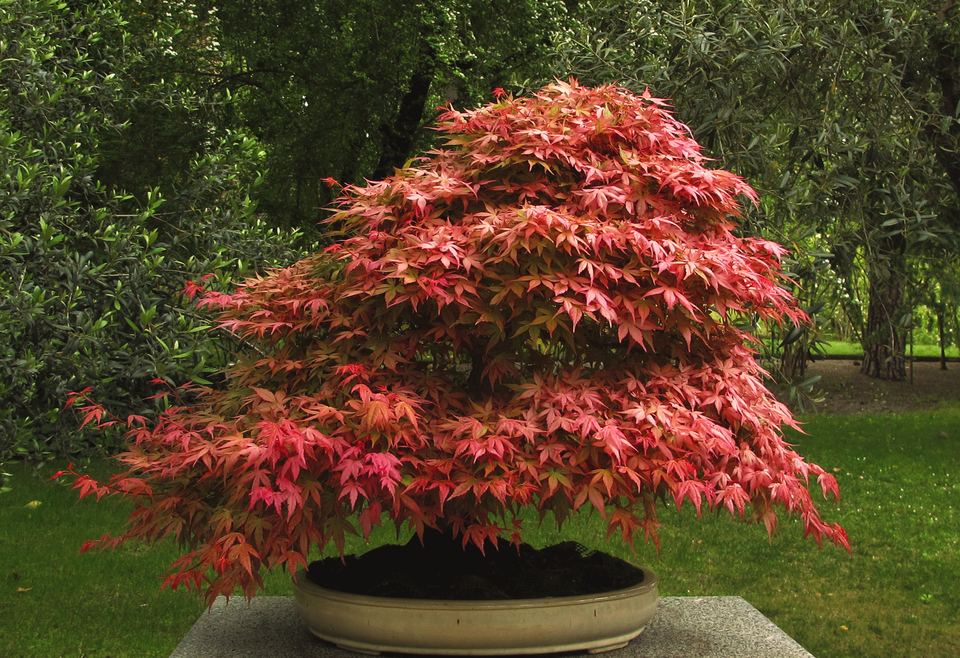
The classic deciduous bonsai, fine-twigged and elegant, with spring and autumn colour; it asks for shade from the midday sun and shelter from wind.
- Lives
- Outdoor
- Hardiness
- RHS H6: hardy in the ground USDA 6b/7a, the RHS's own equivalent.
- Leaves
- broad leaves
- Styles
- informal upright, broom, slanting, forest group, cascade
- Soil
- 2 parts akadama, 1 part pumice, 1 part lava (by volume), sieved to remove dust; a little more akadama for a tree that dries too fast
The year
Timings for a temperate northern climate.
- Repot
- Wire
- Prune
- Pinch
- Protect
- Feed
- Water
- Watch for pests
- J
- F
- M
- A
- M
- J
- J
- A
- S
- O
- N
- D
- JanuaryThe tree is dormant and wants to stay cold.
- FebruaryStill dormant.
- MarchRepot as the buds swell and before the leaves open, usually mid to late March, a little later where spring comes late.
- AprilThe leaves open and the tree is at its most fragile.
- MayGrowth is at full speed and the pot can dry in a few hours on a warm day; water morning and evening if needed.
- JuneThe main pruning month.
- JulyWater is the whole job.
- AugustMuch the same: water, shade, a light feed.
- SeptemberGrowth stops and the tree starts to store for winter.
- OctoberAutumn colour, usually peaking in the second half of the month after a few cool nights.
- NovemberDormant.
- DecemberLeave it alone and keep it cold, damp and out of the wind.
The whole year
- Akadama (hard, medium grade) Check price on Amazon Search eBay
- Pumice (3 to 6 mm) Check price on Amazon Search eBay
- Lava rock (kiryu or black lava, 3 to 6 mm) Check price on Amazon Search eBay
- Drainage mesh and tie-in wire Check price on Amazon Search eBay
- Root hook and rake Check price on Amazon Search eBay
- Bamboo chopsticks (plain) Check price on Amazon Search eBay
- Anodised aluminium wire, 1 to 4 mm Check price on Amazon Search eBay
- Bonsai wire cutter Check price on Amazon Search eBay
- Bonsai shears (long-handled, stainless) Check price on Amazon Search eBay
- Concave branch cutter Check price on Amazon Search eBay
- Cut paste (wound sealant) Check price on Amazon Search eBay
- Slow-release organic fertiliser pellets Check price on Amazon Search eBay
- Frost fleece (frost cloth) Check price on Amazon Search eBay
- Cold frame Check price on Amazon Search eBay
- Pot wrap Check price on Amazon Search eBay
Rules of thumb; your garden varies. The full calendar, with print, PDF and a calendar file.
The whole profile
Acer palmatum is a small tree of the woodland edges and mountain valleys of Japan, Korea and eastern China, where it grows under taller trees in dappled light and damp, well-drained soil. That origin explains almost everything about keeping it anywhere. It does not want full sun through a July afternoon, it does not want its leaves shredded by a dry east wind, and it does not want its roots sitting in water through a wet winter. Give it morning sun, afternoon shade and shelter, and it is one of the most rewarding trees a bonsai grower in this country can own.
It suits bonsai because it does, in miniature, what the big trees do. The leaves are small to begin with and reduce well under pot culture. The twigs ramify finely, so a tree that has been pruned carefully for a few seasons carries a dense, even canopy of fine shoots and reads as a tree even in winter, when there is nothing on it. The bark is smooth and grey, the trunk flares gently at the base, and the whole plant has an elegance that conifers can only approximate. The species itself, the plain green Acer palmatum grown from seed, is usually the best starting point. The named cultivars sold as garden plants are mostly grafted, and a graft union low on the trunk is a lump that never goes away.
Beginners go wrong in three ways. They put the tree in full sun and watch the leaf edges scorch brown in the first warm spell; the tree lives, but the summer is spoiled. They let it dry out once, in May, when a maple in fresh leaf can drink a shallow pot dry between breakfast and tea; the leaves wilt, and the fine shoot tips that would have become next year's ramification die back. And they bring it indoors for the winter to keep it safe, where it either breaks dormancy in January under a radiator or simply desiccates. A Japanese maple is a hardy tree. It needs the cold. What it needs protecting from is the pot freezing solid for days at a time and a wind that dries the twigs while the roots are frozen and cannot replace the water.
Through the year, then: in spring and summer it lives outside in a bright, sheltered spot with shade from about eleven until three. In autumn it can take more sun, which deepens the colour. In winter it stays outside, but in a hard frost the pot goes on the ground against a wall, under a bench, or into an unheated shed or cold frame for the worst of it, out again when the weather softens. A tree that spends the whole winter in a shed will not harden properly and will leaf out early; a few days at a time is the idea, not the whole season.
The maple grows in a flush. Buds swell in late March or April, the leaves open in a week or two of astonishing speed, and the shoots extend until early summer, after which the tree slows and may push a smaller second flush in August if it is strong. It is strongly apically dominant: left alone, the top and the outer tips race away and the inner shoots weaken and die, so the work of keeping a maple is the work of holding that energy back. Pinching the new shoots to the first pair of leaves as they open keeps the internodes short; cutting back the extension in June to one or two pairs of leaves builds the twigging; a partial or full defoliation in June, on a strong tree only, doubles the ramification in a season and gives a smaller second set of leaves. None of that is for a tree that is weak, newly repotted, or in its first year with you.
It responds to wire, but not kindly. The bark marks easily, the branches thicken fast in early summer, and wire left a month too long scars for years. Most growers shape a maple by pruning and by guy wires, and use wire on young shoots in the autumn or early spring when the sap is low, checking it every week. Large cuts heal slowly and should be sealed, and they are best made in late winter, when the tree will bleed least and callus through the spring. Wounds low on the trunk can take several seasons to close.
The seasonal interest is the reason most people keep one. The spring leaves open red or bronze and turn green; the summer canopy is a cool, layered thing that moves in the wind; and in late October, with cool nights and a bit of sun, the leaves go scarlet and orange for a fortnight before they drop. Then the winter silhouette shows what the year's work achieved. A well-ramified maple with its leaves off, on a stand, is as good as bonsai gets in this country. A tree that has spent the year being ignored shows that too, in long bare internodes and a crown of three fat shoots. The difference is not skill so much as attention, little and often, in the right months.
Styles that suit it
- Informal upright (moyogi): the natural habit of the species: a trunk that moves gently with branches held in layered, open pads
- Broom (hokidachi): fine, even twigging from a short straight trunk shows the winter silhouette at its best
- Slanting (shakan): a trunk that leans with the branches balancing it reads naturally for a tree of woodland edges
- Forest group (yose-ue): several thin trunks of different heights make a grove whose autumn colour is the point
- Cascade (kengai): possible with a young, flexible trunk, though the species would rather grow up than down; a style for an experienced hand
Soil, in detail
2 parts akadama, 1 part pumice, 1 part lava (by volume), sieved to remove dust; a little more akadama for a tree that dries too fast
Maples want a mix that holds moisture and still drains freely; fine roots build quickly in akadama, and the pumice and lava keep air in the pot through a wet winter.
Pot
A deciduous tree takes a glazed pot. For a Japanese maple the usual choice is a shallow oval or a soft-cornered rectangle, about two thirds as long as the tree is tall, and about as deep as the trunk is wide at the base. Those two figures are rules of thumb, not laws; a tree with a wide, flat canopy can take a longer pot, and a young tree in training wants something deeper and plainer so the roots can develop.
Glaze colour follows the leaves. Cream, pale blue, soft green and a muted grey-blue all sit well under green summer foliage and let the autumn reds do the work; a red or brown glaze fights the autumn colour. Avoid high-gloss, loud glazes on a tree this refined. A feminine, rounded form suits the species; a heavy, sharp-cornered unglazed pot does not.
Pests and problems
Aphids on the soft spring shoots are the commonest problem, and a pinch between finger and thumb or a jet of water deals with most of them; a soft-soap spray for the rest. Scale insects sometimes appear on the undersides of branches and are picked off. Vine weevil grubs eat the roots of pot plants in many places, and a maple that wilts for no reason, or lifts out of its pot with no roots, has probably been eaten; a nematode drench in late summer and again in spring is the safe treatment.
The leaf problems are mostly not pests. Brown, crisp leaf margins are scorch from sun or wind, not disease. Coral spot, orange pustules on dead wood, means dead branches have been left on the tree; cut back to live wood and seal. Verticillium wilt, where one branch suddenly dies with the leaves still on, is the one serious disease and has no cure; keep the tree strong and do not reuse soil from a tree that has had it.
Basis of each row
What every month's line rests on: RHS H6: hardy in the ground (to about -15 to -20 °C); the roots in a shallow pot are less hardy than the tree in the ground, so the pot needs shelter in a hard frost.
| Month | What to do | Basis |
|---|---|---|
| January | The tree is dormant and wants to stay cold. Leave it outside in a sheltered spot, and move the pot into an unheated shed, garage or cold frame only for the days when the pot would freeze solid or a drying wind is forecast, bringing it out again when the weather softens. Check the soil weekly: it should be damp, never wet, and never bone dry. This is the month to study the bare branch structure and plan the year's pruning. | rhs RHS: Acer palmatum plant page (hardiness H6); RHS advice: Japanese maples (winter care of pot-grown trees) |
| February | Still dormant. Any large structural cuts, removing a branch or shortening the trunk, are best made now, sealed, while the tree is not bleeding sap and can callus through spring. Keep up the frost routine. Towards the end of the month, in a mild year, the buds begin to swell; from then on the tree should not be moved in and out, and the repotting window opens. | reference Harry Harrington, bonsai4me.com species guide (Acer palmatum): structural pruning in late winter; general bonsai practice on sealing cuts |
| March | Repot as the buds swell and before the leaves open, usually mid to late March, a little later where spring comes late. Every two years for a young tree, three to five for an old one. Comb out the roots, remove up to a third on a healthy tree, and set it in fresh mix. Keep a repotted tree out of frost and wind for three or four weeks; a fleece over it on a cold night is enough. No feed until the leaves have hardened. | reference Peter Chan, Bonsai Masterclass (repotting deciduous trees at bud swell); RHS advice: Japanese maples (repot in spring) |
| April | The leaves open and the tree is at its most fragile. A late frost will blacken the new growth, so keep fleece to hand and cover it on clear, still nights when frost is forecast. Begin pinching: as each new shoot opens, pinch out the tip beyond the first pair of leaves on shoots in the crown and outer canopy, and let weak inner shoots run. Water every day the surface dries. | reference Harry Harrington, bonsai4me.com (Acer palmatum: pinching new growth); RHS advice: frost protection of new growth on acers |
| May | Growth is at full speed and the pot can dry in a few hours on a warm day; water morning and evening if needed. Keep pinching the strong shoots. Start feeding once the leaves have hardened, with a balanced liquid feed at half strength every fortnight, or a slow-release organic pellet on the surface. Watch for aphids on the shoot tips. | practice General bonsai practice: feed after the spring leaves harden; RHS advice on aphids |
| June | The main pruning month. Cut back the spring extension to one or two pairs of leaves on every shoot you want to ramify. On a strong, established tree that was not repotted this year, a full or partial defoliation in the first half of June, cutting each leaf at its stalk, gives a second, smaller set of leaves and doubles the twigging; a tree in its first year with you, or anything weak, is left alone. Shade from midday sun matters from now on. | reference Peter Chan, Bonsai Masterclass and Harry Harrington, bonsai4me.com: June defoliation of strong Acer palmatum only |
| July | Water is the whole job. A maple in full leaf in a shallow pot wants water every day and sometimes twice, and a single afternoon bone dry costs it the fine shoot tips. Afternoon shade and shelter from wind keep the leaf edges from scorching. Feed lightly; tidy any long shoots that escaped June. Do not wire now: branches thicken fast and wire bites within weeks. | rhs RHS advice: Japanese maples (leaf scorch from sun and wind, watering container-grown trees) |
| August | Much the same: water, shade, a light feed. A strong tree may push a small second flush; pinch it as in spring. Towards the end of the month a nematode drench against vine weevil grubs, while the soil is warm, protects the roots through autumn. Check any guy wires and the ties on a wired branch. | rhs RHS advice: vine weevil (nematode treatment in late summer when the soil is above about 5 °C) |
| September | Growth stops and the tree starts to store for winter. Switch to a low-nitrogen feed (a tomato feed at half strength does) for the last two feeds of the year, to harden the wood without pushing soft growth. Water less as the days shorten. Let the tree have more sun now; it improves the autumn colour. | practice General bonsai practice: low-nitrogen autumn feed to harden growth; estimate for the effect of sun on colour (widely reported, not measured) |
| October | Autumn colour, usually peaking in the second half of the month after a few cool nights. Stop feeding. Once the leaves have dropped, the structure is visible: this is a good moment for light wiring of young shoots, since the sap is low and the bark marks less, with the wire checked monthly through winter and removed by spring. Clear fallen leaves off the soil to deny pests a home. | reference Harry Harrington, bonsai4me.com (Acer palmatum: wire in autumn after leaf drop or early spring); general practice on hygiene |
| November | Dormant. Water only when the soil surface is dry, which in a wet November may be never; the danger now is waterlogging, so make sure the pot is tilted or raised so it drains. Begin the frost routine: a sheltered spot outside, the shed or cold frame for the hardest nights. Remove any wire that is starting to bite. | rhs RHS advice: overwintering container plants (drainage, raising pots, shelter from the worst frost) |
| December | Leave it alone and keep it cold, damp and out of the wind. Check the pot after each frost that it has drained and that the soil has not been pushed up by ice. A light pruning of crossing twigs can be done any time the tree is bare; the big cuts wait for February. Order soil, wire and a pot now for the spring, because the repotting window is short. | practice General bonsai practice for dormant deciduous trees; RHS guidance on frost protection of pots |