Japanese maple
Acer palmatum
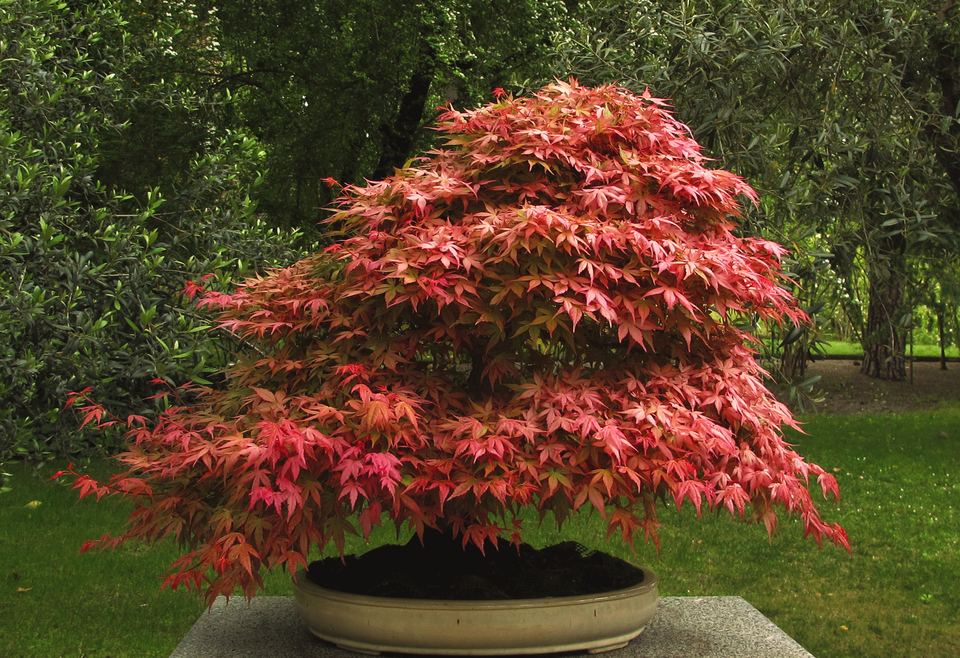

A year of care. RHS H6: hardy in the ground (to about -15 to -20 °C); the roots in a shallow pot are less hardy than the tree in the ground, so the pot needs shelter in a hard frost. USDA 6b/7a, the RHS's own equivalent.
Timings for a temperate northern climate.
- Repot
- Wire
- Prune
- Pinch
- Protect
- Feed
- Water
- Watch for pests
- J
- F
- M
- A
- M
- J
- J
- A
- S
- O
- N
- D
Download as PDF Add to your calendar (.ics)
To print, use your browser's print command; the page is laid out for A4. Neither file carries product links.
- JanuaryThe tree is dormant and wants to stay cold. Leave it outside in a sheltered spot, and move the pot into an unheated shed, garage or cold frame only for the days when the pot would freeze solid or a drying wind is forecast, bringing it out again when the weather softens. Check the soil weekly: it should be damp, never wet, and never bone dry. This is the month to study the bare branch structure and plan the year's pruning.protect, water
- FebruaryStill dormant. Any large structural cuts, removing a branch or shortening the trunk, are best made now, sealed, while the tree is not bleeding sap and can callus through spring. Keep up the frost routine. Towards the end of the month, in a mild year, the buds begin to swell; from then on the tree should not be moved in and out, and the repotting window opens.prune, protect
- MarchRepot as the buds swell and before the leaves open, usually mid to late March, a little later where spring comes late. Every two years for a young tree, three to five for an old one. Comb out the roots, remove up to a third on a healthy tree, and set it in fresh mix. Keep a repotted tree out of frost and wind for three or four weeks; a fleece over it on a cold night is enough. No feed until the leaves have hardened.repot, protect
- AprilThe leaves open and the tree is at its most fragile. A late frost will blacken the new growth, so keep fleece to hand and cover it on clear, still nights when frost is forecast. Begin pinching: as each new shoot opens, pinch out the tip beyond the first pair of leaves on shoots in the crown and outer canopy, and let weak inner shoots run. Water every day the surface dries.pinch, protect, water
- MayGrowth is at full speed and the pot can dry in a few hours on a warm day; water morning and evening if needed. Keep pinching the strong shoots. Start feeding once the leaves have hardened, with a balanced liquid feed at half strength every fortnight, or a slow-release organic pellet on the surface. Watch for aphids on the shoot tips.pinch, feed, water, pests
- JuneThe main pruning month. Cut back the spring extension to one or two pairs of leaves on every shoot you want to ramify. On a strong, established tree that was not repotted this year, a full or partial defoliation in the first half of June, cutting each leaf at its stalk, gives a second, smaller set of leaves and doubles the twigging; a tree in its first year with you, or anything weak, is left alone. Shade from midday sun matters from now on.prune, pinch, water
- JulyWater is the whole job. A maple in full leaf in a shallow pot wants water every day and sometimes twice, and a single afternoon bone dry costs it the fine shoot tips. Afternoon shade and shelter from wind keep the leaf edges from scorching. Feed lightly; tidy any long shoots that escaped June. Do not wire now: branches thicken fast and wire bites within weeks.water, feed
- AugustMuch the same: water, shade, a light feed. A strong tree may push a small second flush; pinch it as in spring. Towards the end of the month a nematode drench against vine weevil grubs, while the soil is warm, protects the roots through autumn. Check any guy wires and the ties on a wired branch.water, feed, pests, pinch
- SeptemberGrowth stops and the tree starts to store for winter. Switch to a low-nitrogen feed (a tomato feed at half strength does) for the last two feeds of the year, to harden the wood without pushing soft growth. Water less as the days shorten. Let the tree have more sun now; it improves the autumn colour.feed, water
- OctoberAutumn colour, usually peaking in the second half of the month after a few cool nights. Stop feeding. Once the leaves have dropped, the structure is visible: this is a good moment for light wiring of young shoots, since the sap is low and the bark marks less, with the wire checked monthly through winter and removed by spring. Clear fallen leaves off the soil to deny pests a home.wire, prune
- NovemberDormant. Water only when the soil surface is dry, which in a wet November may be never; the danger now is waterlogging, so make sure the pot is tilted or raised so it drains. Begin the frost routine: a sheltered spot outside, the shed or cold frame for the hardest nights. Remove any wire that is starting to bite.water, protect, wire
- DecemberLeave it alone and keep it cold, damp and out of the wind. Check the pot after each frost that it has drained and that the soil has not been pushed up by ice. A light pruning of crossing twigs can be done any time the tree is bare; the big cuts wait for February. Order soil, wire and a pot now for the spring, because the repotting window is short.protect, water, prune
What you'll need
Repot
- Akadama (hard, medium grade) Check price on Amazon Search eBay
- Pumice (3 to 6 mm) Check price on Amazon Search eBay
- Lava rock (kiryu or black lava, 3 to 6 mm) Check price on Amazon Search eBay
- Drainage mesh and tie-in wire Check price on Amazon Search eBay
- Root hook and rake Check price on Amazon Search eBay
- Bamboo chopsticks (plain) Check price on Amazon Search eBay
Wire
- Anodised aluminium wire, 1 to 4 mm Check price on Amazon Search eBay
- Bonsai wire cutter Check price on Amazon Search eBay
Prune
- Bonsai shears (long-handled, stainless) Check price on Amazon Search eBay
- Concave branch cutter Check price on Amazon Search eBay
- Cut paste (wound sealant) Check price on Amazon Search eBay
Feed
Protect
Basis of each row
Rules of thumb from the sources named here; your garden, windowsill and weather will differ. These are the rows as sourced, for a temperate climate.
| Month | What to do | Basis |
|---|---|---|
| January | The tree is dormant and wants to stay cold. Leave it outside in a sheltered spot, and move the pot into an unheated shed, garage or cold frame only for the days when the pot would freeze solid or a drying wind is forecast, bringing it out again when the weather softens. Check the soil weekly: it should be damp, never wet, and never bone dry. This is the month to study the bare branch structure and plan the year's pruning. | rhs RHS: Acer palmatum plant page (hardiness H6); RHS advice: Japanese maples (winter care of pot-grown trees) |
| February | Still dormant. Any large structural cuts, removing a branch or shortening the trunk, are best made now, sealed, while the tree is not bleeding sap and can callus through spring. Keep up the frost routine. Towards the end of the month, in a mild year, the buds begin to swell; from then on the tree should not be moved in and out, and the repotting window opens. | reference Harry Harrington, bonsai4me.com species guide (Acer palmatum): structural pruning in late winter; general bonsai practice on sealing cuts |
| March | Repot as the buds swell and before the leaves open, usually mid to late March, a little later where spring comes late. Every two years for a young tree, three to five for an old one. Comb out the roots, remove up to a third on a healthy tree, and set it in fresh mix. Keep a repotted tree out of frost and wind for three or four weeks; a fleece over it on a cold night is enough. No feed until the leaves have hardened. | reference Peter Chan, Bonsai Masterclass (repotting deciduous trees at bud swell); RHS advice: Japanese maples (repot in spring) |
| April | The leaves open and the tree is at its most fragile. A late frost will blacken the new growth, so keep fleece to hand and cover it on clear, still nights when frost is forecast. Begin pinching: as each new shoot opens, pinch out the tip beyond the first pair of leaves on shoots in the crown and outer canopy, and let weak inner shoots run. Water every day the surface dries. | reference Harry Harrington, bonsai4me.com (Acer palmatum: pinching new growth); RHS advice: frost protection of new growth on acers |
| May | Growth is at full speed and the pot can dry in a few hours on a warm day; water morning and evening if needed. Keep pinching the strong shoots. Start feeding once the leaves have hardened, with a balanced liquid feed at half strength every fortnight, or a slow-release organic pellet on the surface. Watch for aphids on the shoot tips. | practice General bonsai practice: feed after the spring leaves harden; RHS advice on aphids |
| June | The main pruning month. Cut back the spring extension to one or two pairs of leaves on every shoot you want to ramify. On a strong, established tree that was not repotted this year, a full or partial defoliation in the first half of June, cutting each leaf at its stalk, gives a second, smaller set of leaves and doubles the twigging; a tree in its first year with you, or anything weak, is left alone. Shade from midday sun matters from now on. | reference Peter Chan, Bonsai Masterclass and Harry Harrington, bonsai4me.com: June defoliation of strong Acer palmatum only |
| July | Water is the whole job. A maple in full leaf in a shallow pot wants water every day and sometimes twice, and a single afternoon bone dry costs it the fine shoot tips. Afternoon shade and shelter from wind keep the leaf edges from scorching. Feed lightly; tidy any long shoots that escaped June. Do not wire now: branches thicken fast and wire bites within weeks. | rhs RHS advice: Japanese maples (leaf scorch from sun and wind, watering container-grown trees) |
| August | Much the same: water, shade, a light feed. A strong tree may push a small second flush; pinch it as in spring. Towards the end of the month a nematode drench against vine weevil grubs, while the soil is warm, protects the roots through autumn. Check any guy wires and the ties on a wired branch. | rhs RHS advice: vine weevil (nematode treatment in late summer when the soil is above about 5 °C) |
| September | Growth stops and the tree starts to store for winter. Switch to a low-nitrogen feed (a tomato feed at half strength does) for the last two feeds of the year, to harden the wood without pushing soft growth. Water less as the days shorten. Let the tree have more sun now; it improves the autumn colour. | practice General bonsai practice: low-nitrogen autumn feed to harden growth; estimate for the effect of sun on colour (widely reported, not measured) |
| October | Autumn colour, usually peaking in the second half of the month after a few cool nights. Stop feeding. Once the leaves have dropped, the structure is visible: this is a good moment for light wiring of young shoots, since the sap is low and the bark marks less, with the wire checked monthly through winter and removed by spring. Clear fallen leaves off the soil to deny pests a home. | reference Harry Harrington, bonsai4me.com (Acer palmatum: wire in autumn after leaf drop or early spring); general practice on hygiene |
| November | Dormant. Water only when the soil surface is dry, which in a wet November may be never; the danger now is waterlogging, so make sure the pot is tilted or raised so it drains. Begin the frost routine: a sheltered spot outside, the shed or cold frame for the hardest nights. Remove any wire that is starting to bite. | rhs RHS advice: overwintering container plants (drainage, raising pots, shelter from the worst frost) |
| December | Leave it alone and keep it cold, damp and out of the wind. Check the pot after each frost that it has drained and that the soil has not been pushed up by ice. A light pruning of crossing twigs can be done any time the tree is bare; the big cuts wait for February. Order soil, wire and a pot now for the spring, because the repotting window is short. | practice General bonsai practice for dormant deciduous trees; RHS guidance on frost protection of pots |
Soil for this species: 2 parts akadama, 1 part pumice, 1 part lava (by volume), sieved to remove dust; a little more akadama for a tree that dries too fast. Tools and materials: starter kits.