Hawthorn
Crataegus monogyna

- 2of 3, difficulty
- 6styles it carries
- Outdoorall year
- NovemberPrune and wire in detail now that the structure is visible, …
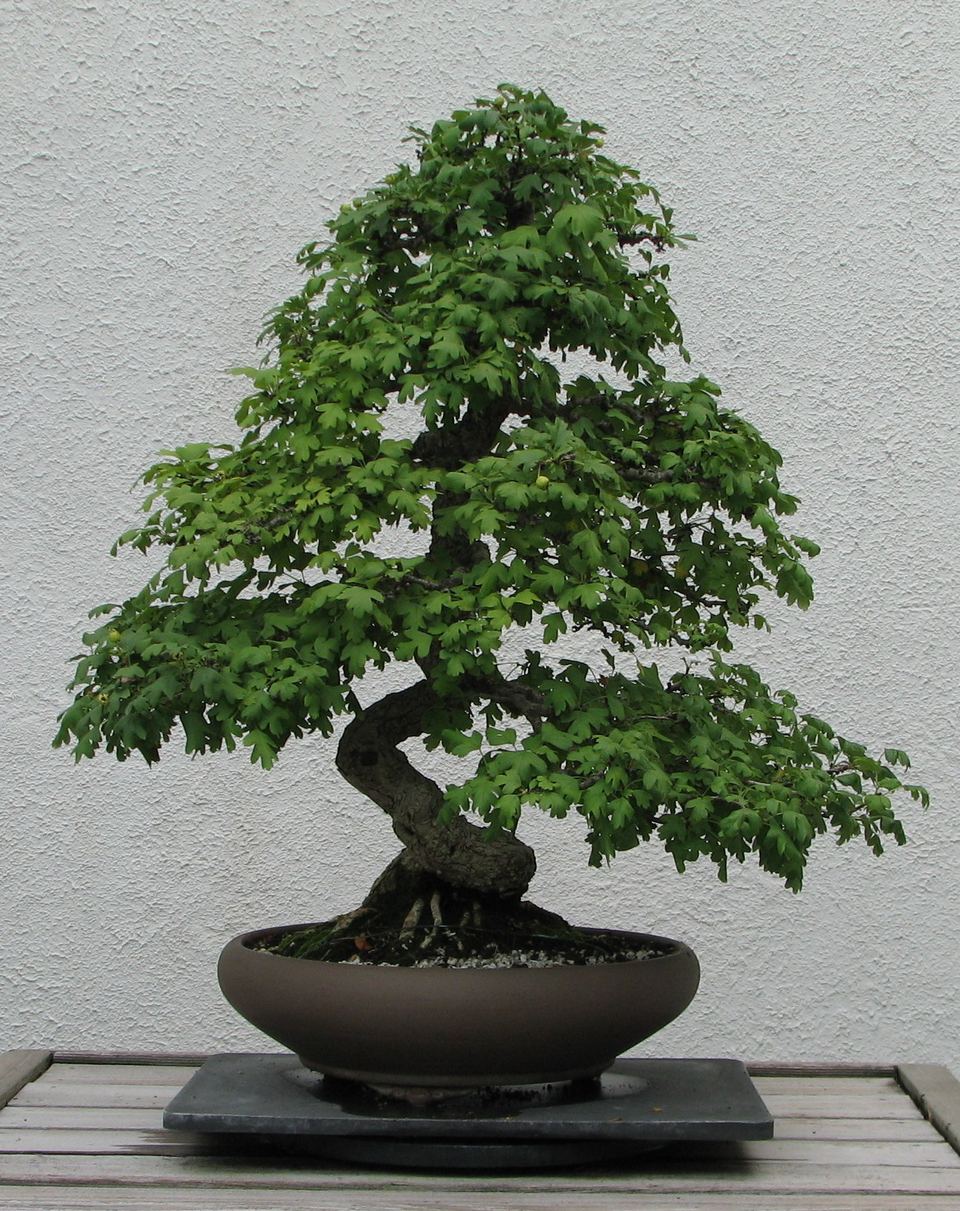
The hedgerow tree as bonsai: small lobed leaves, spring blossom, red haws, and a trunk that grows old and gnarled with character.
- Lives
- Outdoor
- Hardiness
- RHS H7: a common hedgerow tree of Europe, and very hardy. USDA 6a-1, the RHS's own equivalent.
- Leaves
- small leaves
- Styles
- informal upright, slanting, windswept, broom, literati, forest group
- Soil
- 2 parts akadama, 1 part pumice, 1 part lava rock (by volume), 2 to 5 mm, with a little composted bark for a tree in a very small pot
The year
Timings for a temperate northern climate.
- Repot
- Wire
- Prune
- Pinch
- Protect
- Feed
- Water
- Watch for pests
- J
- F
- M
- A
- M
- J
- J
- A
- S
- O
- N
- D
- JanuaryDormant and bare.
- FebruaryStill dormant.
- MarchRepot as the buds swell, every two or three years, removing no more than a third of the roots; hawthorn roots are coarse and slow to recover, so be gentle with a collected tree.
- AprilLeaves open, often late in the month.
- MayFlowering, on trees old enough.
- JuneContinue cutting back extending shoots to two or three leaves as they reach six to eight.
- JulyWater daily, more in heat; hawthorn in a small pot dries fast and drops leaves when stressed.
- AugustKeep watering and feeding.
- SeptemberChange to a low-nitrogen feed.
- OctoberLeaves turn and fall.
- NovemberBare.
- DecemberDormant.
The whole year
- Akadama (hard, medium grade) Check price on Amazon Search eBay
- Pumice (3 to 6 mm) Check price on Amazon Search eBay
- Lava rock (kiryu or black lava, 3 to 6 mm) Check price on Amazon Search eBay
- Drainage mesh and tie-in wire Check price on Amazon Search eBay
- Root hook and rake Check price on Amazon Search eBay
- Bamboo chopsticks (plain) Check price on Amazon Search eBay
- Anodised aluminium wire, 1 to 4 mm Check price on Amazon Search eBay
- Bonsai wire cutter Check price on Amazon Search eBay
- Bonsai shears (long-handled, stainless) Check price on Amazon Search eBay
- Concave branch cutter Check price on Amazon Search eBay
- Cut paste (wound sealant) Check price on Amazon Search eBay
- Slow-release organic fertiliser pellets Check price on Amazon Search eBay
- Frost fleece (frost cloth) Check price on Amazon Search eBay
- Cold frame Check price on Amazon Search eBay
- Pot wrap Check price on Amazon Search eBay
Rules of thumb; your garden varies. The full calendar, with print, PDF and a calendar file.
The whole profile
The common hawthorn is the hedge of Britain. It was planted in its millions during the enclosures and it grows wild on every hillside and waste ground from Cornwall to Caithness: a small, thorny, densely branched tree with small, deeply lobed leaves, a froth of white, musk-scented blossom in May and dark red haws in autumn. Left alone on an exposed site it becomes a crooked, hollow, lichen-covered thing of great age and great character, and that tree, the one on the moor edge or the field corner, is what a hawthorn bonsai sets out to be.
It suits a beginner because it asks for so little. It is completely hardy, it tolerates wet, wind and neglect, it buds from old wood with enthusiasm, and material is everywhere: hedge trimmings that have rooted, seedlings in the garden, and, with the landowner's permission, collected trees whose trunks were shaped by decades of grazing and wind. Hawthorn is a species in which British bonsai has made its own contribution to the art, and many of the best British trees are collected hawthorns.
Beginners go wrong in two ways. The first is impatience with a collected tree: a dug hawthorn can take two or three years to settle and may sulk for a season with few leaves before it throws strong growth, and the temptation to repot or style it in that time usually kills it. The second is cutting the thorns off and the new growth back too hard and too early; hawthorn flowers on old wood, on short spurs, and a tree pruned to a tight silhouette every June will never bloom. Let it extend, then cut back after the flowers, and keep some spurs.
It lives outside all year and asks for full sun to flower and fruit well. In winter it needs nothing in most of the country beyond a pot kept out of standing water; in a hard freeze move it under cover so the roots are not frozen solid for days. It leafs out late, often not until mid-April, and the bare months show the ramification, which is one of the pleasures of the species: a well-developed hawthorn has twigs as fine as a hedge.
Growth is strong and the tree buds freely from the trunk and old branches, so it can be cut back hard and rebuilt. Shoots extend quickly in late spring and should be cut back to two or three leaves once they have made six or eight, except on the spurs you want to flower. The wood is hard and brittle; young shoots wire well but older branches snap rather than bend, so an old hawthorn is shaped by pruning and by choosing which shoots to keep, not by wiring. The thorns are real and long; gloves are not vanity.
Hawthorn roots are coarse and fleshy and the tree often has a poor root system when first collected, so repotting is cautious: every two or three years, never removing more than a third, and always into a well-draining mix. It can be slow to make fine feeder roots, and a tree that has been in the same pot for a few years with strong growth is in no hurry to be moved.
The seasonal interest is the richest of any native species. Bronze-tinted new leaves in April, white blossom with a faint pink cast in May on a tree old enough to flower, deep green summer foliage that turns yellow and russet in October, and red haws that hang into winter if the birds allow it. The bark becomes grey, plated and fissured, and a trunk of any age looks older than it is. A hawthorn in flower on a bench in May is the moment many growers point to as the reason they keep trees.
Styles that suit it
- Informal upright (moyogi): a hedgerow hawthorn has a trunk that twists and leans and corrects itself; informal upright is simply what the species does.
- Slanting (shakan): field hawthorns bent by the prevailing wind lean for life, and the style suits a collected tree with a strong one-sided trunk.
- Windswept (fukinagashi): the tree of the exposed hillside; a windswept hawthorn is one of the few bonsai a walker will recognise from life.
- Broom (hokidachi): the fine, twiggy ramification hawthorn builds makes a convincing broom crown on a short, stout trunk.
- Literati (bunjin): an old hawthorn with a thin, scarred trunk and a sparse crown is a common sight on a moor edge and translates directly.
- Forest group (yose-ue): a group of seedlings on a slab makes a hedgerow in miniature, and the species flowers and fruits together.
Soil, in detail
2 parts akadama, 1 part pumice, 1 part lava rock (by volume), 2 to 5 mm, with a little composted bark for a tree in a very small pot
Hawthorn is not fussy in the ground and tolerates clay, but in a pot it wants the same open, free-draining mix as other deciduous trees so the roots stay healthy through a wet winter; a touch of organic matter helps a small pot hold water in summer.
Pot
A flowering tree takes a glazed pot, and hawthorn's white blossom and red fruit carry a soft blue, a cream or a muted green glaze well; a dark glaze makes the tree look heavier than it is. The rule of thumb holds: a length about two thirds of the height, a depth about the width of the trunk base. Hawthorn's coarse roots like a pot at the deeper end of the rule.
An oval suits an informal or slanting tree; a shallow round or a drum suits a literati; a windswept tree sits toward one end of a plain oval. A rustic, unglazed pot is not wrong for a gnarled collected tree whose character is all in the trunk, where a bright glaze would compete, so the rule bends for the tree in front of you.
Pests and problems
Aphids crowd the soft new shoots in spring and are dealt with by hand or with a soap spray. Caterpillars of several moths eat the leaves in May and June; pick them off. Hawthorn is a host for the same pests as apples and pears, so expect occasional leaf-mining and gall mites, none of which threaten the tree.
The disease to know is fireblight, which blackens flowers and shoots as if they had been burned and can kill a tree; cut well below any affected growth and disinfect the tools. Hawthorn leaf spot and powdery mildew mark the leaves in a wet or close summer and are kept down by air and light. Rust shows as orange spots and is a nuisance rather than a danger. A tree that drops some leaves early in a dry August is conserving water, not dying.
Basis of each row
What every month's line rests on: RHS H7: a common hedgerow tree of Europe, and very hardy. A pot does not change that much, though the roots in a shallow pot are less hardy than the tree in the ground and should not be left frozen solid for days..
| Month | What to do | Basis |
|---|---|---|
| January | Dormant and bare. Keep the pot out of standing water and, in a prolonged hard freeze, under cover. Water only when the soil is dry below the surface. The bare tree can be studied and lightly pruned for structure while every twig is visible. | rhs RHS: Crataegus monogyna plant page (H7); RHS advice: overwintering plants in containers |
| February | Still dormant. Finish structural pruning of unwanted branches. Check and remove old wire. Have soil ready for repotting next month. | practice general bonsai practice: winter structural pruning of deciduous trees |
| March | Repot as the buds swell, every two or three years, removing no more than a third of the roots; hawthorn roots are coarse and slow to recover, so be gentle with a collected tree. Set it in an open mix and shelter it from frost and wind for three to four weeks. Do not feed a freshly repotted tree until it is in leaf. | reference Harry Harrington, bonsai4me.com: Crataegus species guide (repotting, root sensitivity of collected trees) |
| April | Leaves open, often late in the month. Begin a balanced feed once the tree is in leaf. Water as the surface dries. Watch for aphids on the new growth. | practice general bonsai practice: feeding from leaf-out; RHS advice: aphids |
| May | Flowering, on trees old enough. Let the shoots extend; do not prune during flowering. Water daily in dry weather and feed fortnightly. After the flowers fade, cut extending shoots back to two or three leaves, keeping the short spurs that flowered. | reference Bonsai Empire: Hawthorn bonsai care guide (prune after flowering; flowers on old wood); RHS: Crataegus monogyna (flowering in May) |
| June | Continue cutting back extending shoots to two or three leaves as they reach six to eight. Wire young shoots that have hardened slightly; older wood snaps, so shape by pruning. Water daily and feed fortnightly. Look for caterpillars and leaf spot. | reference Harry Harrington, bonsai4me.com: Crataegus (brittle wood; clip-and-grow); general practice |
| July | Water daily, more in heat; hawthorn in a small pot dries fast and drops leaves when stressed. Feed at half strength. Light pruning of strong shoots only. Keep in full sun for next year's flower buds to form. | practice general bonsai practice; RHS advice: watering container plants |
| August | Keep watering and feeding. Stop pruning by the end of the month so the tree can ripen its wood and set flower buds on the spurs. Thin any dense inner growth so light reaches the trunk. | practice general bonsai practice: stop pruning late summer for flower bud formation on spur-flowering trees |
| September | Change to a low-nitrogen feed. Water as needed. Haws colour on a fruiting tree; leave them for the colour, though removing most of a heavy crop spares a small tree the effort. | practice general bonsai practice: autumn feeding; thinning fruit on small trees |
| October | Leaves turn and fall. Stop feeding. Reduce watering. Clear fallen leaves off the soil to discourage fungus. Check for fireblight symptoms before the tree goes bare. | rhs RHS advice: fireblight (symptoms, hygiene); general autumn practice |
| November | Bare. Prune and wire in detail now that the structure is visible, remembering that only young shoots bend. Water sparingly. Move an exposed tree to shelter before the first hard frosts. | reference Peter Chan, Bonsai Masterclass (winter work on deciduous trees); general practice |
| December | Dormant. Keep the root ball from freezing solid for days by moving the pot under cover in a hard freeze; do not water a frozen pot. Otherwise leave the tree in the open; hawthorn needs the cold. | rhs RHS advice: protecting plants from frost; Crataegus monogyna H7 |