Chinese elm
Ulmus parvifolia

- 1of 3, difficulty
- 7styles it carries
- Eitherall year
- NovemberMove the tree to a sheltered spot out of the wind.
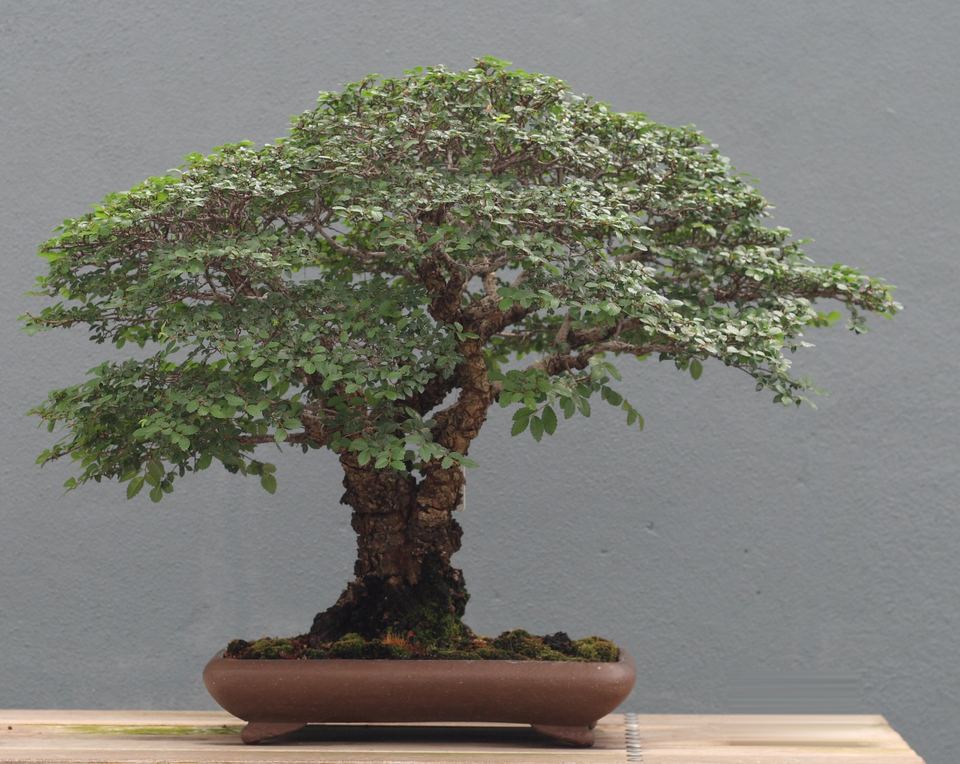
Small leaves, fast fine twigging and a forgiving nature make the Chinese elm the best first bonsai of all, outdoors or in a cool bright room.
- Lives
- Either
- Hardiness
- RHS H7 in the ground USDA 6a-1, the RHS's own equivalent.
- Leaves
- small leaves
- Styles
- informal upright, broom, slanting, root over rock, forest group, cascade, literati
- Soil
- 2 parts akadama, 1 part pumice, 1 part lava (by volume); a touch more akadama for a tree kept indoors and watered often
The year
Timings for a temperate northern climate.
- Repot
- Wire
- Prune
- Pinch
- Protect
- Feed
- Water
- Watch for pests
- J
- F
- M
- A
- M
- J
- J
- A
- S
- O
- N
- D
- JanuaryOutdoors: the tree is bare and dormant; keep the pot from freezing solid by moving it under cover below about -5 °C, and check it is not bone dry on a sunny day.
- FebruaryBuds begin to swell late in the month.
- MarchRepot as the buds swell and before they open, every two years young and three or four later: roots back by about a third, into a free-draining mix, water well, keep out of frost for a fortnight.
- AprilThe spring flush.
- MayKeep pruning shoots back as they extend, which is what builds the fine twigging.
- JuneAs May.
- JulyPeak growth.
- AugustLast pruning of the year by the end of the month so new growth can harden before autumn.
- SeptemberAn indoor tree comes back to its cool sill before the first cool nights, usually early to mid September.
- OctoberOutdoors the leaves begin to turn and drop late in the month; clear fallen leaves from the pot surface to stop fungus overwintering.
- NovemberOutdoor trees drop their last leaves and show their winter silhouette; this is the month to study the branch structure and plan winter pruning.
- DecemberFully dormant outdoors.
The whole year
- Akadama (hard, medium grade) Check price on Amazon Search eBay
- Pumice (3 to 6 mm) Check price on Amazon Search eBay
- Lava rock (kiryu or black lava, 3 to 6 mm) Check price on Amazon Search eBay
- Drainage mesh and tie-in wire Check price on Amazon Search eBay
- Root hook and rake Check price on Amazon Search eBay
- Bamboo chopsticks (plain) Check price on Amazon Search eBay
- Anodised aluminium wire, 1 to 4 mm Check price on Amazon Search eBay
- Bonsai wire cutter Check price on Amazon Search eBay
- Bonsai shears (long-handled, stainless) Check price on Amazon Search eBay
- Concave branch cutter Check price on Amazon Search eBay
- Cut paste (wound sealant) Check price on Amazon Search eBay
- Slow-release organic fertiliser pellets Check price on Amazon Search eBay
- Frost fleece (frost cloth) Check price on Amazon Search eBay
- Cold frame Check price on Amazon Search eBay
- Pot wrap Check price on Amazon Search eBay
Rules of thumb; your garden varies. The full calendar, with print, PDF and a calendar file.
The whole profile
Ulmus parvifolia is a small elm from China, Korea and Japan, with grey-brown bark that flakes to orange in age, small toothed leaves no more than a few centimetres long, and a habit of branching finely and often. Unlike the English elms lost to Dutch elm disease, it is resistant to the fungus, and it is a common street tree in warm temperate cities. As a bonsai it has been grown for centuries in China and is the species most often sold as a first tree, usually as a young S-curved trunk imported in its thousands and potted on arrival.
It is easy to place because it is a tree of two minds. Outdoors in a sheltered garden it is a hardy deciduous tree, turning yellow in November and standing bare until a late spring flush. In a cool bright room it keeps most of its leaves through the winter and behaves as a semi-evergreen, which is why it is sold as an indoor bonsai. Either life works, and the tree will cope with a change between them, but it does best when it has one life and keeps it; the worst outcome is a tree moved indoors and out as the whim takes you, which will drop its leaves at every move. If you have a garden, grow it outside. If you do not, a cool windowsill in an unheated or lightly heated room, or an unheated porch, is better than a warm living room.
Beginners go wrong in two ways. The first is to treat it as a tropical houseplant and keep it warm, dim and wet over winter: in a heated room with poor light the tree stretches, drops leaves from the inside and is weakened by spring. It wants light and coolness in winter, and a cold, bright spot is a better winter home than a warm, dark one. The second is to keep the roots wet. The mix a shop tree comes in is often dense and holds water for days; in that, in a cool room, the fine roots die. The first job with a new tree is a slow drying out and, at the right season, a move into a free-draining mix. Watering then follows the tree, not the calendar: soak the pot when the surface is dry, and in a warm spell outdoors that can mean every day.
An outdoor elm lives on a bench or a low wall with sun for most of the day and shelter from the worst wind, and it goes under cover, into an unheated shed, a cold greenhouse or a cold frame, when hard frost is forecast, say below about minus 5 degrees, because the roots in a small pot freeze solid long before the tree in the ground would. It comes out again when the weather turns. An indoor elm spends October to May on its cool sill and June to September outside in a sheltered spot, where it will grow more in three months than it did all winter. Both move only when they need to.
The elm is prized for its twigging. Every shoot pruned back to two or three leaves produces two or more finer shoots, and a crown of dense, fine ramification builds within a few seasons from a stick with three branches. It back-buds on old wood after a hard cut, so a tree that has got away can be rebuilt. It is not strongly apically dominant, which is why its crown fills out rather than running away at the top, but the leader still needs pinching in summer or it thickens out of proportion. Branches wire well while young and set in a season; older branches are stiff and should be positioned with guy wires rather than bent. The bark marks easily, so wire comes off before it bites.
There is seasonal interest in every month outdoors: the fresh pale flush in April and May, the fine summer crown, a clear butter yellow in November on a tree that has had enough light, and the winter silhouette of thousands of twigs that is the whole point of the broom style. In age the bark begins to flake in small plates, orange underneath, which is the mark of a tree that has been kept for decades. Indoors the show is quieter; the tree holds its leaves and may drop and replace them in late winter, which can look alarming and is normal.
Repotting is an early spring job, as the buds swell and before they open, every two years for a young tree and three or four for an older one, with the roots cut back by about a third; the tree is vigorous and recovers fast. Feeding is fortnightly from the spring flush to early autumn with a balanced liquid feed, then nothing, and a slow, low-nitrogen feed in autumn for an outdoor tree hardens the wood before winter. Every figure here is a rule of thumb that your tree, your garden and your window will adjust.
Styles that suit it
- Informal upright (moyogi): a gently curving trunk with a domed crown of fine twigs is what the species does by itself when pruned regularly
- Broom (hokidachi): the elm's dense, even branching from a straight trunk is the classic broom, and it builds in a few seasons
- Slanting (shakan): the trunk bends and sets easily when young, and the fine crown balances a lean well
- Root over rock (sekijoju): the roots are vigorous and thicken quickly, so they grip a stone within a few years
- Forest group (yose-ue): cheap, uniform young trees make a convincing group, and the small leaf reads at scale
- Cascade (kengai): possible with young, flexible material wired down early, though the tree will keep pushing an upward leader to be pinched back
- Literati (bunjin): a tall thin trunk with a small crown of fine twigs reads well, though the bark takes years to look old
Soil, in detail
2 parts akadama, 1 part pumice, 1 part lava (by volume); a touch more akadama for a tree kept indoors and watered often
A vigorous, thirsty root system that still rots in a wet, airless pot: the mix must drain freely and hold a little water in the particles rather than between them.
Pot
A deciduous tree takes a glazed pot, by the old rule, and the elm's fine crown looks best over something quiet: an oval or a soft rectangle in cream, pale blue, grey-green or an unglazed-looking brown glaze. The length is about two thirds of the tree's height; the depth about the width of the trunk at the base. A broom-style tree, wider than tall, takes a length of about two thirds of its spread and sits a little off centre.
A forest takes a shallow oval tray or a slab; a root-over-rock tree a shallow tray that leaves the stone as the main event; a literati elm a small round or drum pot, taller than the rule would give. For an indoor tree, a touch deeper than the rule is forgiving, because the mix dries more evenly.
Pests and problems
Outdoors the Chinese elm is troubled by little: aphids on the soft spring growth, which a jet of water or a soap spray clears, and occasionally the elm leaf beetle, whose larvae skeletonise leaves in summer and are picked off. It is resistant to Dutch elm disease, which is why it can be grown at all where that disease is established. A black spot on the leaves in a wet summer is a leaf-spot fungus and is cleaned up by removing fallen leaves and improving air around the tree.
Indoors the usual houseplant pests appear: scale along the twigs, which is wiped off, and red spider mite in a warm, dry room, which stipples and yellows the leaves and is set back by humidity and a wash under the shower. A sudden leaf drop indoors is nearly always light, a draught or a wet pot rather than a pest.
Basis of each row
What every month's line rests on: RHS H7 in the ground (https://www.rhs.org.uk/plants/21508/ulmus-parvifolia/details, checked 30 Oct 2026: hardy in the severest European climates, deciduous to semi-evergreen). The roots in a shallow bonsai pot are far less hardy than the tree, so a potted Chinese elm is treated as about H4: sheltered, and under cover below about -5 °C. Indoors it is semi-evergreen and keeps most of its leaves..
| Month | What to do | Basis |
|---|---|---|
| January | Outdoors: the tree is bare and dormant; keep the pot from freezing solid by moving it under cover below about -5 °C, and check it is not bone dry on a sunny day. Indoors: a cool, bright sill, water only when the surface is dry. | rhs RHS: Ulmus parvifolia, https://www.rhs.org.uk/plants/21508/ulmus-parvifolia/details (H7 in the ground); RHS advice: overwintering container plants (pot roots are less hardy than the tree) |
| February | Buds begin to swell late in the month. Prepare the repotting kit. Indoors, the tree may drop and replace old leaves now; that is normal if the new buds are green. Wipe scale off the twigs while they are bare. | practice general bonsai practice for deciduous trees in late winter |
| March | Repot as the buds swell and before they open, every two years young and three or four later: roots back by about a third, into a free-draining mix, water well, keep out of frost for a fortnight. Structural pruning of larger branches is done now, before the sap rises fully. | reference Harry Harrington, bonsai4me.com species guide: Ulmus parvifolia; Peter Chan, Bonsai Masterclass (repotting deciduous trees at bud swell) |
| April | The spring flush. Start feeding fortnightly once the first leaves have hardened. Let shoots extend to six or eight leaves, then cut back to two or three. An indoor tree moves outside at the end of the month in a mild year, after the last frost in your area. | practice general bonsai practice (clip-and-grow on elms); last-frost timing from RHS advice: frost protection |
| May | Keep pruning shoots back as they extend, which is what builds the fine twigging. Wire young shoots while green; check it monthly, the bark marks fast. Water daily in a warm spell outdoors. Watch for aphids on the soft growth. | reference Bonsai Empire species guide: Chinese elm; RHS advice: aphids |
| June | As May. A strong, healthy tree can be partly defoliated now to reduce leaf size and let light into the crown; leave the weak and the recently repotted alone. Feed fortnightly. | reference Harry Harrington, bonsai4me.com: defoliation (healthy deciduous trees in early summer); Peter Warren, Bonsai (DK) |
| July | Peak growth. Prune extended shoots back to two or three leaves, pinch the leader so it does not thicken out of proportion. Never let the pot dry out in a heatwave: morning and evening checks. Elm leaf beetle larvae, if any, are picked off. | practice general bonsai practice for summer maintenance of deciduous trees |
| August | Last pruning of the year by the end of the month so new growth can harden before autumn. Remove wire that is starting to bite. Keep feeding, moving to a lower-nitrogen feed late in the month. | practice general bonsai practice; the switch to a low-nitrogen autumn feed is common UK practice, not a measured rule |
| September | An indoor tree comes back to its cool sill before the first cool nights, usually early to mid September. Outdoor trees stay out. Feed with a low-nitrogen feed to harden the wood. No more pruning or wiring. | estimate the move-in date is our judgement from average first cool nights for England; autumn feeding from general practice |
| October | Outdoors the leaves begin to turn and drop late in the month; clear fallen leaves from the pot surface to stop fungus overwintering. Stop feeding. Reduce watering as the tree slows. Indoors, water less as the light drops. | practice general bonsai practice; leaf hygiene from RHS advice: leaf spot |
| November | Outdoor trees drop their last leaves and show their winter silhouette; this is the month to study the branch structure and plan winter pruning. Move the tree to a sheltered spot out of the wind. Indoors, a cool bright sill and sparing water. | practice general bonsai practice for deciduous trees entering dormancy |
| December | Fully dormant outdoors. Protect from hard frost under cover; a cold frame or unheated shed is ideal, a heated room is not. Check for dryness on dry windy days. Indoors, as November; do nothing but water correctly. | rhs RHS advice: overwintering container plants (frost protection for pot-grown roots); RHS: Ulmus parvifolia (H7 (in the ground; about H4 in a pot)) |