Larch
Larix decidua and Larix kaempferi
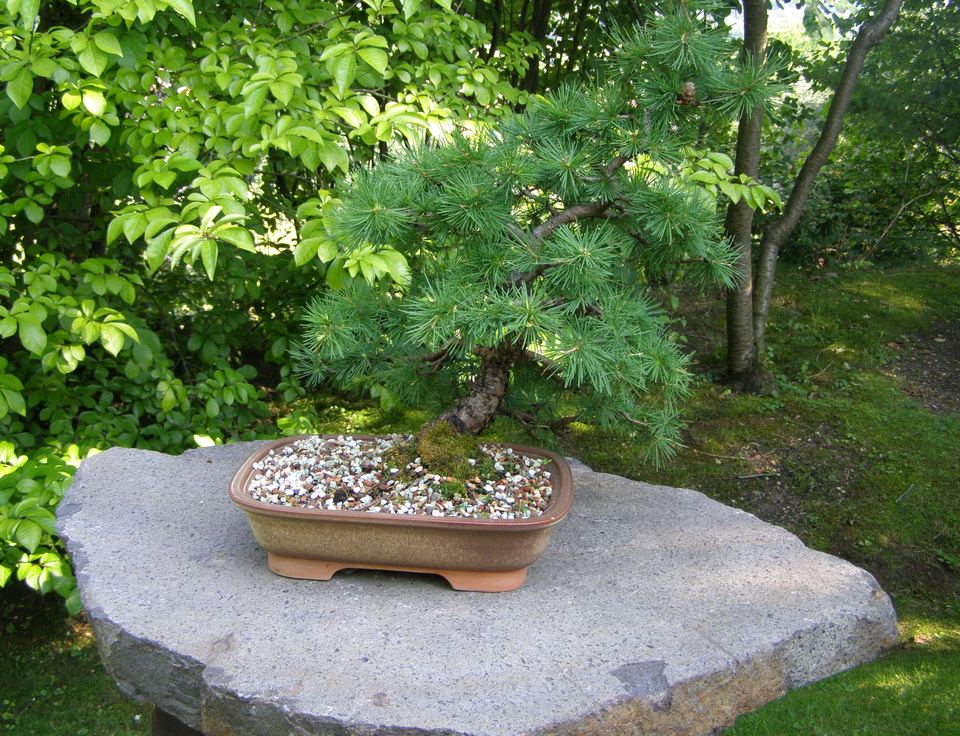

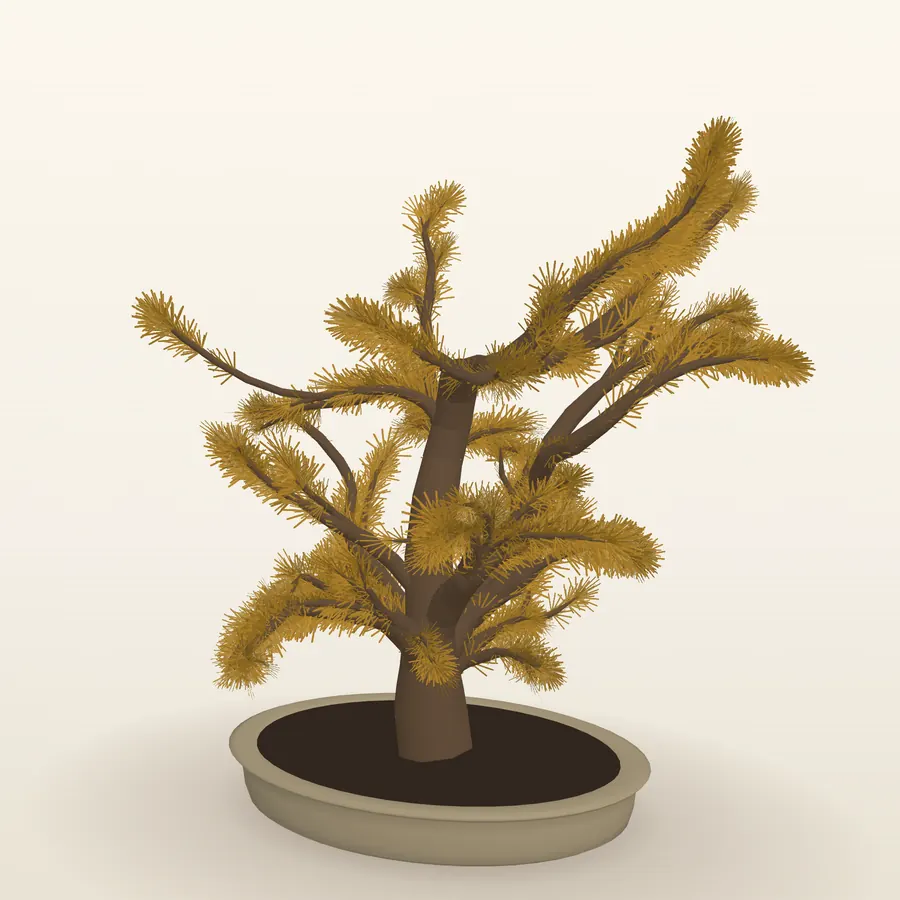
- 1of 3, difficulty
- 6styles it carries
- Outdoorall year
- NovemberAfter leaf fall the tree is bare and can be wired and pruned…
A deciduous conifer that is fast, forgiving and cheap, with soft spring green, gold autumn needles and a fine winter silhouette.
- Lives
- Outdoor
- Hardiness
- RHS H7 for European larch; Japanese larch is rated the same. USDA 6a-1, the RHS's own equivalent.
- Leaves
- needles
- Styles
- informal upright, formal upright, slanting, literati, forest group, windswept
- Soil
- 2 parts akadama, 1 part pumice, 1 part lava rock (by volume), 2 to 5 mm
The year
Timings for a temperate northern climate.
- Repot
- Wire
- Prune
- Pinch
- Protect
- Feed
- Water
- Watch for pests
- J
- F
- M
- A
- M
- J
- J
- A
- S
- O
- N
- D
- JanuaryDormant and bare.
- FebruaryThe buds begin to swell towards the end of the month, earlier than most trees.
- MarchFinish repotting early in the month if the buds are still closed; once the green tufts show, leave the roots alone until next year.
- AprilThe needles open.
- MayGrowth is fast.
- JuneContinue pinching the second flush as it extends.
- JulyWater generously and feed at half strength.
- AugustWater daily and feed.
- SeptemberChange to a low-nitrogen feed to ripen the wood.
- OctoberThe needles turn gold.
- NovemberAfter leaf fall the tree is bare and can be wired and pruned in detail; branches set over winter.
- DecemberDormant.
The whole year
- Akadama (hard, medium grade) Check price on Amazon Search eBay
- Pumice (3 to 6 mm) Check price on Amazon Search eBay
- Lava rock (kiryu or black lava, 3 to 6 mm) Check price on Amazon Search eBay
- Drainage mesh and tie-in wire Check price on Amazon Search eBay
- Root hook and rake Check price on Amazon Search eBay
- Bamboo chopsticks (plain) Check price on Amazon Search eBay
- Anodised aluminium wire, 1 to 4 mm Check price on Amazon Search eBay
- Bonsai wire cutter Check price on Amazon Search eBay
- Copper wire (for conifers, once you're comfortable wiring) Check price on Amazon Search eBay
- Bonsai shears (long-handled, stainless) Check price on Amazon Search eBay
- Concave branch cutter Check price on Amazon Search eBay
- Slow-release organic fertiliser pellets Check price on Amazon Search eBay
- Frost fleece (frost cloth) Check price on Amazon Search eBay
- Cold frame Check price on Amazon Search eBay
- Pot wrap Check price on Amazon Search eBay
Rules of thumb; your garden varies. The full calendar, with print, PDF and a calendar file.
The whole profile
Larch is the conifer that drops its needles. The European larch comes from the Alps and Carpathians and has been planted across Britain for timber since the seventeenth century; the Japanese larch, with its slightly bluer needles and reddish shoots, came later and is now the commoner forestry tree in the wetter west. Both are tall, straight, fast-growing trees in the plantation and both take on a craggy, open-branched character on a mountainside, with small cones held upright along the branches like beads.
For a bonsai grower larch is a gift. It is fully hardy, it grows in cool summers faster than almost any other conifer, and seedlings are sold cheaply by forestry nurseries. It buds freely from old wood, which no pine or juniper will do, so mistakes can be grown out. It thickens a trunk in a few seasons in a large pot or the open ground, and it accepts hard pruning and heavy wiring. It is, in short, the species on which to learn how a conifer responds to work without risking a tree that took forty years to grow.
The mistakes are particular to the species. Larch is deciduous, and every autumn a beginner somewhere throws a healthy larch away believing it has died; the needles turn gold, then drop, and the tree stands bare until April. The second error is repotting at the wrong moment: the buds swell early, often in February, and once the needle tufts have opened the roots dislike being disturbed. The third is to let it dry out in a hot spell; a larch in full leaf uses a great deal of water and wilts quickly, and a shoot that wilts hard does not always recover.
It lives outside all year in full sun or light shade, and in truth it prefers a cool, bright, airy spot to a hot, sheltered one. Winter care is simple: keep the pot from sitting in water, and during a long hard freeze move it into a cold frame so the roots are not frozen and thawed daily. It needs no shelter from ordinary frost and resents being kept too warm, which starts the buds too early.
The growth is strong and apical: a larch pushes hardest at the top and at the tips of its branches, so a design has to keep the apex and the outer shoots in check or the interior and lower branches weaken and die. Shoots are pinched or cut back in late spring once they have made a few needle tufts, and the second flush in summer is treated the same way. The buds set along the bare branch will open if light reaches them, which is how a larch is kept compact. Branches thicken quickly, so wire must be checked within weeks in spring and early summer, and the bark, which becomes attractively plated with age, scars easily if the wire bites.
Cones form on quite young trees and are small and decorative; they can be left on for a season. The bark reddens and flakes with age, and the trunk of an old larch has the character of a much older tree in another species. Larch also layers and roots readily, so a branch that is in the wrong place can become a new tree.
The seasonal interest is the point of the species. In April the bare branches break into tufts of the softest green in the garden; through summer the foliage is a fine, feathery mid-green; in October and November it turns butter yellow and then a deep gold before it falls, and in winter the tree stands as a line drawing of itself, every branch and bud visible, which is when a larch is judged and when it is best worked.
Styles that suit it
- Informal upright (moyogi): a young larch grows fast and bends easily, so a trunk with movement is built in a few seasons rather than found.
- Formal upright (chokkan): the natural habit is a straight trunk with tiered branches; formal upright is the species at rest.
- Slanting (shakan): larches on a slope lean and then correct upward, and the pliable trunk is wired into that line while it is still a pencil.
- Literati (bunjin): the bare winter trunk and sparse branching are forgiving of a thin, tall design, and the species thickens slowly enough to keep it.
- Forest group (yose-ue): larch seedlings are cheap by the dozen, grow at a predictable rate, and a group on a slab colours together in autumn.
- Windswept (fukinagashi): young branches are easily set to one side and the tree's mountain origins make the story believable.
Soil, in detail
2 parts akadama, 1 part pumice, 1 part lava rock (by volume), 2 to 5 mm
Larch drinks more than other conifers in summer, so it takes a slightly more water-retentive mix than a pine, but it still rots in a sodden pot; akadama with grit holds water and drains.
Pot
As a conifer, larch takes an unglazed pot, though its colouring is warmer than a pine's and it carries a deep brown or a muted iron-red clay well. The rule of thumb holds: a length about two thirds of the height, a depth about the width of the base of the trunk. Larch roots are vigorous, so a pot at the deeper end of the rule is kinder than a very shallow one.
A rectangle suits an upright or slanting tree; a forest sits on a shallow oval tray or a flat slab with a soil wall built up on it; literati takes a small drum. Because the tree is bare for five months, the pot is on show for longer than with an evergreen, so a well-made plain pot earns its keep.
Pests and problems
Larch adelgid is the common pest, a woolly aphid that covers the needles and shoots in white fluff in spring and early summer; a horticultural soap or a strong jet of water controls it, and a tree in good light and air is less troubled. Aphids on the soft new growth are routine. Caterpillars, including the larch casebearer, can strip tufts in May; pick them off.
The serious disease is Phytophthora ramorum, which has killed plantation larch across the west of Britain; a bonsai is at low risk but the species should not be collected from or near affected woodland, and any branch that dies back suddenly with bleeding bark should be cut out and burned. Larch canker shows as sunken, resinous patches on the bark; keep the tree open and dry. A larch that goes yellow and drops its needles in October is doing what larches do.
Basis of each row
What every month's line rests on: RHS H7 for European larch; Japanese larch is rated the same. A mountain tree and very hardy, but the roots in a pot are less hardy than the tree, so keep the root ball from freezing solid for days on end..
| Month | What to do | Basis |
|---|---|---|
| January | Dormant and bare. Keep the pot from standing in water; move it into a cold frame or against a wall for a prolonged hard freeze and back out afterwards. Water only when the soil is dry below the surface. This is a good month to study the branch structure and plan the year's pruning while every bud can be seen. | rhs RHS: Larix decidua plant page (H7); RHS advice: overwintering plants in containers |
| February | The buds begin to swell towards the end of the month, earlier than most trees. Repot as soon as they do, every two years for a young tree and three to four for an older one, taking up to a third of the roots; do not wait for March in a mild year. Prune unwanted branches and do structural wiring now while the tree is bare. | reference Harry Harrington, bonsai4me.com: Larix species guide (repot as buds swell, before the needles open); Peter Chan, Bonsai Masterclass |
| March | Finish repotting early in the month if the buds are still closed; once the green tufts show, leave the roots alone until next year. Keep a repotted tree sheltered from frost and wind for three to four weeks. Begin watering more often as the buds open. | reference Harry Harrington, bonsai4me.com: Larix (timing of repotting against bud break) |
| April | The needles open. Start feeding with a balanced feed once the tufts are out, fortnightly at first. Water as the surface dries, which quickly becomes daily. Check any wire put on in February, as the branches start to thicken now. | practice general bonsai practice: feeding with the first growth; RHS advice: feeding container plants |
| May | Growth is fast. Pinch or cut back extending shoots once they have made four or five tufts, leaving two or three, strongest first, to keep the tree compact and push strength into the interior buds. Water daily and feed fortnightly. Watch for adelgid fluff and deal with it early. | reference Bonsai Empire: Larch bonsai care guide (pinching new growth); RHS advice: adelgids |
| June | Continue pinching the second flush as it extends. Water daily, twice in heat; a larch in leaf wilts fast. Feed fortnightly. Remove wire that is beginning to mark the bark; larch thickens quickly in early summer. | practice general bonsai practice: larch wire checks every few weeks in early summer |
| July | Water generously and feed at half strength. Keep the tree in a bright, airy place rather than a hot, enclosed one. Light pinching only; the main work is over until autumn. | practice general bonsai practice; RHS advice: watering container plants in summer |
| August | Water daily and feed. Thin crowded shoots so light reaches the inner buds that will form next year's growth. Avoid hard pruning in the heat. | practice general bonsai practice: late-summer thinning for interior budding |
| September | Change to a low-nitrogen feed to ripen the wood. Water as needed. Wiring can be done now on hardened shoots, though the bare months after leaf fall are easier. | practice general bonsai practice: autumn low-nitrogen feeding |
| October | The needles turn gold. Stop feeding. Reduce watering as the tree slows. Enjoy the colour; do nothing structural until the needles have dropped. | rhs RHS: Larix decidua plant page (deciduous conifer, autumn colour) |
| November | After leaf fall the tree is bare and can be wired and pruned in detail; branches set over winter. Clean fallen needles off the soil surface. Water sparingly. Move an exposed tree to shelter before hard frosts. | reference Harry Harrington, bonsai4me.com: Larix (wiring after leaf fall); Peter Warren, Bonsai (DK) |
| December | Dormant. Keep the root ball from freezing solid for long by moving the pot under cover in a hard freeze; do not water a frozen pot. Keep it cool: a larch brought somewhere warm will start into growth far too early. | rhs RHS advice: protecting plants from frost; overwintering plants in containers |