Ficus
Ficus microcarpa (sold as F. retusa, "ginseng" and tiger-bark forms)

- 1of 3, difficulty
- 6styles it carries
- Indoorall year
- NovemberShort days: the tree is ticking over, not growing.
The most forgiving indoor bonsai for any home; a bright window, steady warmth and a light hand with the watering can are most of the job.
- Lives
- Indoor
- Hardiness
- RHS H1b USDA 12, the RHS's own equivalent.
- Leaves
- broad leaves
- Styles
- informal upright, broom, root over rock, slanting, cascade, forest group
- Soil
- 2 parts akadama, 1 part pumice, 1 part lava, with a small handful of composted bark if the room is dry (by volume)
The year
Timings for a temperate northern climate.
- Repot
- Wire
- Prune
- Pinch
- Protect
- Feed
- Water
- Watch for pests
- J
- F
- M
- A
- M
- J
- J
- A
- S
- O
- N
- D
- JanuaryKeep the tree on the brightest sill you have and the pot clear of the radiator's heat.
- FebruaryAs January.
- MarchLight is returning and the tree will start to push new leaves.
- AprilWater more often as growth speeds up.
- MayRepot now if it is due (every two years young, three or four later): tease out the roots, cut back by about a third, back into a free-draining mix, water well and keep out of direct sun for a fortnight.
- JuneMove the tree outside once nights are reliably above about 10 to 12 °C, to a sheltered spot with morning sun and afternoon shade.
- JulyThe main growing month.
- AugustAs July.
- SeptemberBring the tree back indoors before the first cool nights, usually early to mid September, and expect some leaf drop as it settles.
- OctoberBack on the brightest sill.
- NovemberShort days: the tree is ticking over, not growing.
- DecemberAs November.
The whole year
- Akadama (hard, medium grade) Check price on Amazon Search eBay
- Pumice (3 to 6 mm) Check price on Amazon Search eBay
- Lava rock (kiryu or black lava, 3 to 6 mm) Check price on Amazon Search eBay
- Drainage mesh and tie-in wire Check price on Amazon Search eBay
- Root hook and rake Check price on Amazon Search eBay
- Bamboo chopsticks (plain) Check price on Amazon Search eBay
- Anodised aluminium wire, 1 to 4 mm Check price on Amazon Search eBay
- Bonsai wire cutter Check price on Amazon Search eBay
- Bonsai shears (long-handled, stainless) Check price on Amazon Search eBay
- Concave branch cutter Check price on Amazon Search eBay
- Cut paste (wound sealant) Check price on Amazon Search eBay
- Slow-release organic fertiliser pellets Check price on Amazon Search eBay
Rules of thumb; your garden varies. The full calendar, with print, PDF and a calendar file.
The whole profile
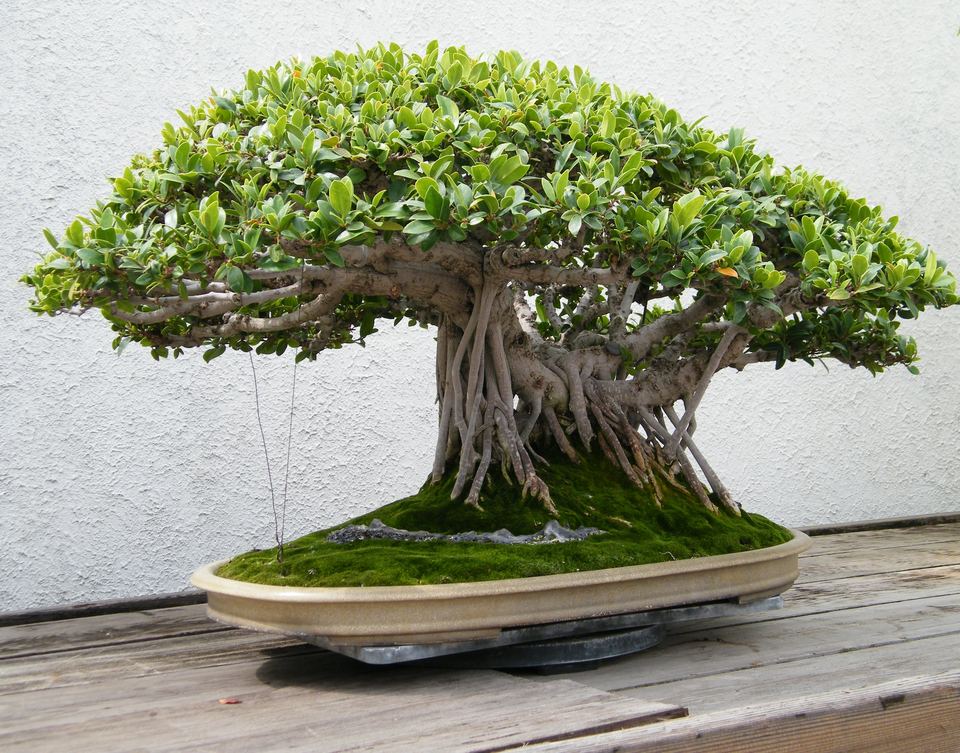
Ficus microcarpa is a fig from the tropics of southern China, India and Malaysia, where it grows into a wide, spreading tree with a grey trunk, glossy leaves and the aerial roots that drop from its branches and thicken into extra trunks. Most of the ficus sold as bonsai are this species or its close relatives, under names that shift from shop to shop. "Ficus retusa" is the old label and still appears on tags. "Ginseng ficus" is a form grown for a swollen, bulbous root that is then potted high so that the roots stand as a trunk. The tiger-bark forms, with pale flecks on the bark and smaller leaves, are the ones most worth having, because they look like trees rather than root vegetables.
It is the right first indoor tree for a house because it tolerates what a house does to a plant. It copes with dry air better than any other indoor bonsai, it does not sulk for long when it is moved, it buds back readily from old wood, and it tells you clearly when it is unhappy by dropping leaves, then grows them again when the problem is fixed. Within a year a beginner can see the difference that pruning makes, which is the lesson that keeps people in the hobby. The warm, humid summer that a ficus would prefer is not something most rooms can offer, so growth is slower indoors than the books written for warmer places suggest, and that slowness is nothing to worry about.
The commonest mistakes are about light and water. A ficus wants the brightest window you have, ideally south or west facing, with the pot close to the glass; a tree set back on a shelf or on a north sill will thin out, stretch and drop leaves from the inside of the crown. Central heating is the other winter problem, not because of the warmth but because a radiator directly under the sill bakes the pot dry and cooks the roots on one side. Watering is where most trees are lost. The mix should be allowed to dry on the surface between waterings, then soaked through until water runs from the drainage holes; a pot kept wet in a cool, dark room in January will rot. The "ginseng" form bought from a supermarket, already in dense peat, is the hardest to keep going, and the sooner it is moved into a free-draining mix the better.
Through the year the tree lives on a bright windowsill from October to May. From roughly June to September it can go outside, in a sheltered spot with morning sun and shade from the hottest afternoon, once night temperatures are reliably above about 10 to 12 °C. It will grow more in those three months than in the other nine. Bring it back in before the first cool nights of autumn, usually early to mid September, and expect a few leaves to drop as it adjusts to the house. Keep it away from doors that open onto cold air and from the direct blast of a radiator.
A ficus grows from the tips and from any node that is cut back to, and it is not strongly dominated by its apex, so a crown can be built from the base up by pruning and letting it regrow. Shoots are pruned back to two or three leaves once they have extended to six or eight, and the leaves can be reduced in size by defoliating a healthy, vigorous tree in early summer, though a tree in a cool room rarely has the energy for that more than once in a season. Branches wire easily while green and set within a few months; older wood is brittle and the bark marks quickly, so wire is checked monthly. Cuts bleed a white latex that dries in minutes and seals the wound. Aerial roots appear in humid conditions and can be guided down into the soil to thicken the trunk base.
It is an evergreen, so there is no autumn show and no winter silhouette; the interest is the glossy leaf, the pale trunk, the surface roots and, on the better forms, the mottled bark. A healthy tree keeps most of its leaves all year and flushes with fresh, lighter growth in spring and again in late summer. If it flowers it does so almost invisibly, inside small figs that may follow in a warm year and should be removed so the tree spends nothing on them.
Repotting is a late spring job, when the days are long and the house is warm, every two years for a young tree and every three or four for an established one; the roots are pruned by about a third and the tree goes back into the same or a slightly larger pot. Feeding runs from spring to early autumn with a balanced liquid feed at half strength every fortnight, and stops over winter when the tree is only ticking over. None of these figures is a rule. Watch the tree, and let what it does in your room, in your light, decide.
Styles that suit it
- Informal upright (moyogi): the natural habit of a tree that is pruned back hard and allowed to regrow is a gently moving trunk with a rounded crown
- Broom (hokidachi): fine twigging develops quickly from repeated pruning, and the broad crown reads well on a short, stout trunk
- Root over rock (sekijoju): aerial and surface roots thicken fast and will grip a stone within a few seasons in a warm room
- Slanting (shakan): a lean towards the light is something a windowsill ficus does on its own; the style makes it deliberate
- Cascade (kengai): long, flexible shoots can be wired down while young, though the tree will keep trying to grow upward
- Forest group (yose-ue): rooted cuttings of one plant make a group of matched trees in a year or two
Soil, in detail
2 parts akadama, 1 part pumice, 1 part lava, with a small handful of composted bark if the room is dry (by volume)
A ficus is watered often indoors, so the mix must drain in seconds and still hold some moisture between drinks; the bark adds a little water-holding without the sogginess of multi-purpose compost.
Pot
A ficus takes a glazed pot, as the rule of thumb gives every broad-leaved tree, and a fairly deep one, because the roots are coarse and the tree is watered often. The length is about two thirds of the tree's height, or two thirds of the width of a broad, low crown; the depth is about the width of the trunk at the base, which on a root-potted ginseng form is the width of the swollen roots, so those trees sit in pots deeper than their height suggests.
Ovals and soft-cornered rectangles suit the rounded, informal crowns; a round or drum pot suits a single-trunk tree with a broom top. Glazes in cream, pale blue, sea green and a muted brown all work against the dark leaf; bright reds and blues fight it. A root-over-rock tree takes a shallow oval or a tray.
Pests and problems
Indoors the enemies are the ones that like dry, still air. Scale insects sit as small brown bumps along the stems and the leaf midribs and are picked or wiped off with a cotton bud and diluted washing-up liquid, then watched for. Mealy bug shows as white fluff in the leaf axils and is dealt with the same way. Red spider mite arrives in a hot, dry room, stipples the leaves yellow and spins fine webbing; raising humidity and rinsing the foliage under the shower sets it back, and a soap or oil spray finishes it.
Sudden leaf drop is a response to change, not a pest: a move, a draught, a cold night by the glass, or a pot kept too wet. Fix the cause and the tree refoliates within weeks. Sticky leaves and sooty mould point to scale or mealybug above them.
Basis of each row
What every month's line rests on: RHS H1b (https://www.rhs.org.uk/plants/32855/ficus-microcarpa/details, checked 30 Oct 2026): can be grown outside in summer, minimum 10 to 15 °C; a warm, bright room the rest of the year.
| Month | What to do | Basis |
|---|---|---|
| January | Keep the tree on the brightest sill you have and the pot clear of the radiator's heat. Water only when the surface of the mix is dry, then thoroughly; in a cool room that may be once a week or less. No feeding, no pruning beyond removing a dead twig. | rhs RHS: Ficus microcarpa, https://www.rhs.org.uk/plants/32855/ficus-microcarpa/details (H1b: outside in summer only, minimum 10 to 15 °C; full or filtered light under glass); RHS advice: houseplant care in winter |
| February | As January. Check the undersides of leaves and the stems for scale and mealybug, which build up unseen in a warm, dry house; wipe them off. Mist or stand the pot on a tray of wet gravel if the air is very dry. | practice general bonsai practice for indoor figs in winter; pest checks from RHS advice: scale insects, mealybugs |
| March | Light is returning and the tree will start to push new leaves. Begin feeding at half strength once new growth shows. Turn the pot a quarter turn each week so the crown grows evenly. | practice general bonsai practice; feeding resumes with growth, not by the calendar |
| April | Water more often as growth speeds up. Wire young shoots now while they are green and flexible; they set in two to three months. First light pruning of shoots that have extended well beyond the crown's outline. | reference Harry Harrington, bonsai4me.com species guide: Ficus; Bonsai Empire species guide: Ficus bonsai |
| May | Repot now if it is due (every two years young, three or four later): tease out the roots, cut back by about a third, back into a free-draining mix, water well and keep out of direct sun for a fortnight. Prune back extended shoots to two or three leaves. | reference Peter Chan, Bonsai Masterclass (indoor figs: repot in late spring when warm); Bonsai Empire species guide: Ficus |
| June | Move the tree outside once nights are reliably above about 10 to 12 °C, to a sheltered spot with morning sun and afternoon shade. Water daily in warm weather, check the pot morning and evening in a heatwave. Feed fortnightly. A strong tree can be defoliated now to reduce leaf size; a weak one must not be. | estimate the 10 to 12 °C threshold is our rule of thumb from RHS H1b (minimum 10 °C) and general practice for moving tender plants out after frosts |
| July | The main growing month. Keep pruning shoots back to two or three leaves as they reach six to eight. Check wire every few weeks: ficus bark marks fast. Guide any aerial roots down to the soil if you want the trunk base to thicken. | reference Harry Harrington, bonsai4me.com species guide: Ficus (pruning and wiring); Peter Warren, Bonsai (DK) |
| August | As July. Watch for red spider mite in a hot, dry spell; rinse the foliage and treat if needed. Keep feeding fortnightly; a tree that has been defoliated gets a little extra. | rhs RHS advice: glasshouse red spider mite (hot, dry conditions); general bonsai practice for summer pruning |
| September | Bring the tree back indoors before the first cool nights, usually early to mid September, and expect some leaf drop as it settles. Last pruning of the year early in the month; stop wiring new work. Reduce feeding to monthly. | estimate the move-in date is our judgement from Met Office average first-cool-nights for England and the H1b minimum; practice on stopping work before winter |
| October | Back on the brightest sill. Water less as the light drops; let the surface dry between waterings. Stop feeding by the end of the month. Keep away from doors and draughts. | practice general bonsai practice for indoor trees as daylight falls; RHS advice: houseplant care in winter |
| November | Short days: the tree is ticking over, not growing. Water sparingly and only with water at room temperature. A grow light on a timer, 10 to 12 hours a day, makes a real difference in a dark house but is not essential. | practice general bonsai practice; grow-light hours are a common rule of thumb for indoor figs, not a measured figure |
| December | As November. Do nothing to the tree except water it correctly and keep it warm and lit. Wipe dust from the leaves so they catch what light there is. Plan next year's work while the tree rests. | practice general bonsai practice for tender evergreens in a British winter |